
13 Hidden Layers Protecting Your Brain! ️ | Inside Your Head (3D)
13 Hidden Layers Protecting Your Brain: Inside the Ultimate Biological Fortress The human brain is the most complex and powerful supercomputer in the known univer...
Medically Reviewed By
Medscope Editorial Team Verified
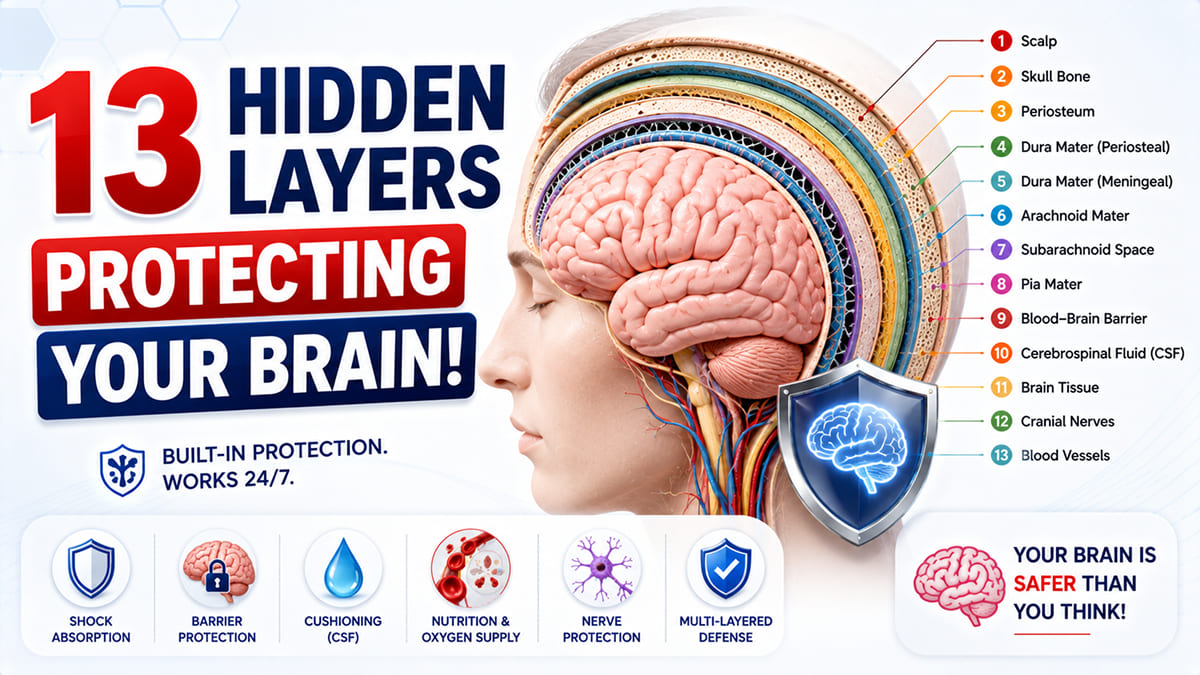
13 Hidden Layers Protecting Your Brain: Inside the Ultimate Biological Fortress
The human brain is the most complex and powerful supercomputer in the known universe. It controls your every thought, heartbeat, memory, and movement. However, despite its immense computing power, the physical tissue of the brain is incredibly fragile. Unprotected, the brain has the physical consistency of soft gelatin or soft tofu. If it were subjected to even a minor impact, it would suffer catastrophic, irreversible damage.
Because the brain is so vital and delicate, human evolution has engineered a spectacular biological fortress around it. Before anything from the outside world can touch your actual brain tissue, it must penetrate 13 distinct, highly specialized anatomical layers of defense. Let us take a fascinating 3D journey inside the human head to uncover the 13 hidden layers protecting your mind.
The Outer Defenses: The S.C.A.L.P. (Layers 1 to 6)
The first line of defense is what covers your head. In medical anatomy, the layers covering the skull are easily remembered using the famous mnemonic S.C.A.L.P. (Skin, Connective tissue, Aponeurosis, Loose areolar tissue, and Pericranium).
Layer 1: The Hair
Before even touching the skin, the very first layer of protection is your hair. Hair acts as a physical sensory net and a primary thermal insulator, preventing excess heat loss from the head and shielding the scalp from damaging UV radiation from the sun.
Layer 2: The Skin (Epidermis & Dermis)
The skin on your scalp is some of the thickest skin on the human body. It is packed with sebaceous glands and hair follicles. This layer acts as a tough, waterproof barrier that keeps deadly bacteria, viruses, and pathogens out of your head.
Layer 3: Dense Connective Tissue
Directly beneath the skin lies a thick, fibrous layer of dense connective tissue. This layer is highly vascular, meaning it is densely packed with a massive network of blood vessels and nerves. (This is exactly why even a very small cut on your head bleeds so heavily!). It acts as a resilient cushion against blunt force trauma.
Layer 4: The Aponeurosis (Epicranial Aponeurosis)
Also known as the Galea Aponeurotica, this is a very tough, fibrous sheet of tendon-like muscle tissue. It connects the front muscle of your forehead (frontalis) to the back muscle of your head (occipitalis). It acts as a structural helmet, tightly holding the upper layers of the scalp together.
Layer 5: Loose Areolar Tissue
This is a spongy, sponge-like layer that allows the upper three layers of your scalp to slide and glide smoothly over your skull. In clinical medicine, this is often called the "Danger Zone of the Scalp" because if an infection reaches this loose layer, it can easily spread across the entire head and travel down into the brain through emissary veins.
Layer 6: The Pericranium (Periosteum)
This is a very thin, dense biological membrane that is tightly glued directly to the outer surface of the skull bone. It provides essential blood supply and nutrients to the living bone tissue of the skull.
The Ultimate Armor: The Skull (Layer 7)
Layer 7: The Skull Bone (Cranium)
Once you get past the soft tissues of the scalp, you hit the ultimate biological armor: The Cranium. The skull is an incredibly strong, vaulted structure made of highly calcified bone. The bones of the skull (like the frontal, parietal, and occipital bones) are actually made of three sub-layers: a hard outer plate, a spongy middle layer (the diploë) that absorbs the shock of physical blows, and a hard inner plate. The skull acts as an impenetrable physical safe for the brain.
The Inner Fortress: The Meninges and Fluid (Layers 8 to 13)
You might think the brain sits directly against the skull, but that would be disastrous! If the soft brain rubbed directly against the hard, rigid bone during everyday movements, it would suffer severe friction damage. Therefore, nature created the Meninges—three specialized protective membranes, separated by critical spaces.
Layer 8: The Epidural Space
This is a microscopic "potential space" located immediately beneath the skull bone and just above the first meningeal membrane. Normally, there is no space here, but in the event of severe head trauma, torn arteries can bleed into this area, creating a highly dangerous condition called an Epidural Hematoma.
Layer 9: The Dura Mater (The Tough Mother)
The Latin translation of Dura Mater is "Tough Mother," and the name is perfectly accurate. This is the outermost meningeal layer. It is a thick, incredibly strong, leather-like membrane that tightly wraps around the brain. It is so tough that neurosurgeons must use a sharp scalpel to cut through it. It provides robust mechanical support to the brain.
Layer 10: The Subdural Space
Beneath the dura mater lies another potential space known as the Subdural Space. It contains a very thin film of lubricating fluid and a network of fragile bridging veins. Head injuries can cause these veins to tear, resulting in a Subdural Hematoma.
Layer 11: The Arachnoid Mater (The Spider Web)
The middle layer of the meninges is called the Arachnoid Mater because it looks exactly like a delicate, translucent spider web under a microscope. This web-like structure is designed to act as a brilliant biological shock absorber. It suspends the brain, preventing it from violently slamming into the skull during sudden movements or whiplash.
Layer 12: The Subarachnoid Space (The Water Cushion)
This space is arguably the most vital defensive layer. The Subarachnoid Space is entirely filled with a crystal-clear liquid called Cerebrospinal Fluid (CSF).
The CSF acts as a hydraulic water cushion. It provides Buoyancy to the brain. The human brain actually weighs about 1,500 grams (1.5 kg), but because it is completely floating in this pool of CSF, its effective weight drops to just 50 grams! Without this fluid, the brain would collapse under its own heavy weight and crush its lower blood vessels.
Layer 13: The Pia Mater (The Tender Mother)
The final, deepest layer of defense is the Pia Mater. Unlike the tough Dura, the Pia Mater is a microscopic, ultra-thin, and highly delicate membrane that is shrink-wrapped directly onto the exact contours of the brain's surface. It dives deep into every fold (sulcus) and bump (gyrus) of the cerebral cortex. The Pia Mater is heavily packed with thousands of tiny, microscopic capillaries that deliver fresh, oxygenated blood directly into the brain tissue.
Conclusion
The next time you tap your head, take a moment to appreciate the masterpiece of engineering inside it. Before any force can reach the delicate neurons that store your memories and personality, it must penetrate hair, skin, tough connective tissues, hard bone, leather-like membranes, spider-web shock absorbers, and a hydraulic fluid cushion. These 13 hidden layers work flawlessly together, 24 hours a day, ensuring that the command center of your body remains safe, secure, and functioning perfectly.