
5 Foods Your Joints Love | Science-Backed Foods for Healthy Joints
5 Foods Your Joints Love: The Medical Science of Joint Health When we experience joint pain, stiffness, or the early signs of arthritis, our immediate biological...
Medically Reviewed By
Medscope Editorial Team Verified
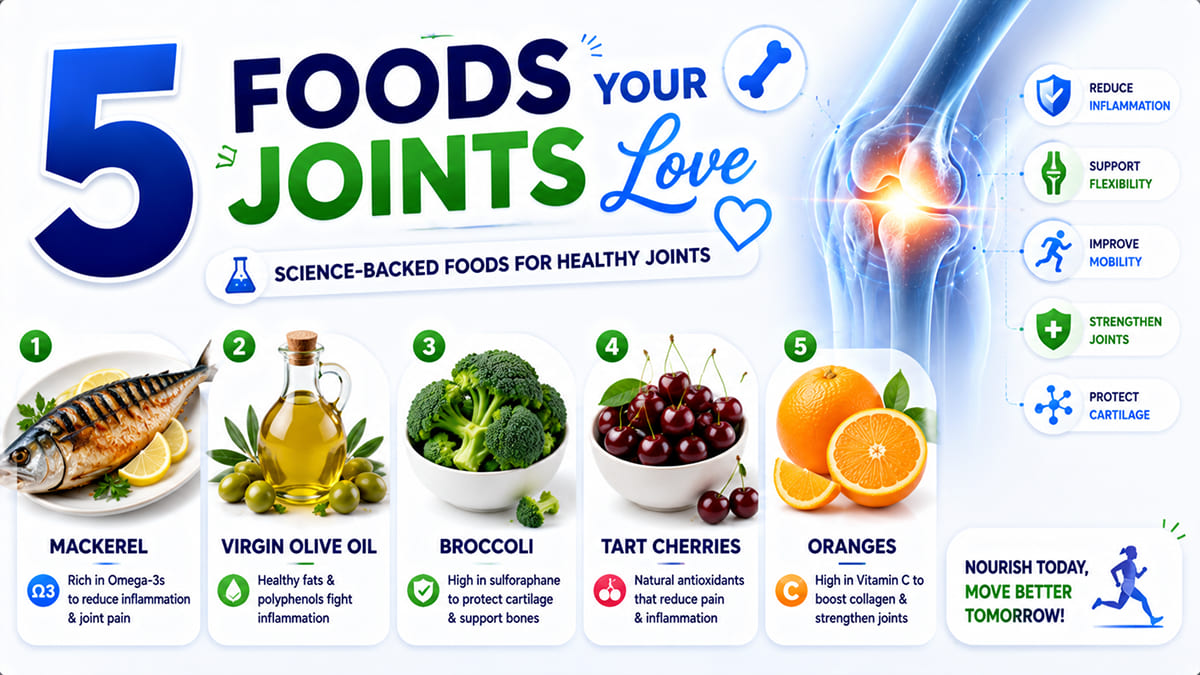
5 Foods Your Joints Love: The Medical Science of Joint Health
When we experience joint pain, stiffness, or the early signs of arthritis, our immediate biological instinct is to reach for a chemical painkiller. However, modern nutritional science and rheumatology have proven a fundamental truth: Food is not just for filling your stomach; it is the ultimate medicine for your joints. The foods you consume on a daily basis have the physiological power to either trigger massive systemic inflammation or actively heal and protect your cartilage.
To maintain pain-free mobility as we age, we must understand that joint pain is primarily an inflammatory and structural issue. By strategically feeding our bodies the right biochemical compounds, we can actively turn off inflammatory genes, lubricate our moving parts, and rebuild damaged cartilage. Let us dive deep into the medical science behind 5 powerful, science-backed superfoods that your joints absolutely love.
The Anatomy of a Joint: Why Do They Hurt?
Before exploring the foods, we must quickly understand how a normal Synovial Joint (like your knee, shoulder, or hip) works. The ends of your bones are covered in a smooth, white, rubbery tissue called Cartilage, which acts as a biological shock absorber. The entire joint is enclosed in a capsule filled with a thick, slippery liquid called Synovial Fluid. This fluid lubricates the joint, allowing the bones to glide past each other without friction.
Joint pain (Osteoarthritis or Rheumatoid Arthritis) occurs when chronic inflammation aggressively attacks this system. The synovial fluid dries up, and the protective cartilage breaks down. Eventually, raw bone grinds against raw bone, causing excruciating pain. The following 5 foods are scientifically proven to stop this destructive cycle.
1. Mackerel (Fatty Fish): The Ultimate Lubricant
Fatty fish, particularly Mackerel, Salmon, and Sardines, are considered the holy grail of joint health by orthopedic doctors and dietitians alike.
The Science: Mackerel is incredibly rich in marine Omega-3 fatty acids, specifically EPA (Eicosapentaenoic Acid) and DHA (Docosahexaenoic Acid). When you consume these Omega-3s, they enter your cellular membranes and directly block the production of pro-inflammatory cytokines and enzymes (like interleukins and COX-2).
Furthermore, these Omega-3 fatty acids actively improve the viscosity (thickness and slipperiness) of your Synovial Fluid. By enriching this joint fluid, Omega-3s ensure that your bones glide smoothly without rubbing against each other.
Clinical Tip: To get the maximum therapeutic benefit, aim to eat wild-caught fatty fish at least 2 to 3 times a week.
2. Extra Virgin Olive Oil: The Natural Ibuprofen
The Mediterranean diet is famous for its joint-protecting properties, and its foundation is Extra Virgin Olive Oil (EVOO). This golden liquid contains a specific pharmacological compound that mimics over-the-counter medication.
The Science: Extra Virgin Olive Oil contains a unique phenolic compound known as Oleocanthal. Remarkably, pharmacological studies have shown that Oleocanthal works exactly like Ibuprofen (a standard NSAID painkiller). It acts as a non-selective inhibitor of the Cyclooxygenase (COX) enzymes. By physically blocking these pain-causing and inflammation-causing enzymes, Oleocanthal reduces joint swelling at a molecular level.
Clinical Tip: Always choose "Extra Virgin" cold-pressed olive oil. Refined or heavily heated olive oils destroy the delicate Oleocanthal compound, completely robbing you of its anti-inflammatory medical benefits.
3. Broccoli: The Gene Switcher
Broccoli and other cruciferous vegetables (like Brussels sprouts and cabbage) are structural powerhouses that actively protect your joint matrix.
The Science: Broccoli contains a highly potent sulfur-rich compound called Sulforaphane. In epigenetic studies, Sulforaphane has been proven to physically turn off (downregulate) the specific genes that cause inflammation and joint destruction. It literally stops the biochemical signals that tell your body to destroy its own cartilage. Additionally, broccoli is packed with Vitamin K and Calcium, which are essential for maintaining the dense bone structure beneath the cartilage.
Clinical Tip: Do not over-boil your broccoli! Boiling destroys the enzyme (myrosinase) needed to form Sulforaphane. To preserve its medical properties, lightly steam the broccoli for just 3 to 4 minutes before eating.
4. Tart Cherries: The Gout Destroyer
If you have ever suffered from Gout (a highly painful form of inflammatory arthritis), Tart Cherries are one of the most effective natural treatments available in clinical nutrition.
The Science: Gout is caused by Hyperuricemia—abnormally high levels of Uric Acid in the blood. When uric acid levels get too high, they form sharp, microscopic, needle-like crystals that deposit directly into the joints (most commonly the big toe), causing severe, fiery pain.
Tart cherries are loaded with deep red antioxidants called Anthocyanins. These powerful antioxidants actively help the kidneys filter out and dissolve these painful uric acid crystals, safely flushing them out of the body through urine. Clinical trials have proven that consuming tart cherries can reduce the risk of sudden gout attacks by an incredible 35% while also reducing general muscle soreness.
Clinical Tip: Always opt for "Tart" (sour) cherries or pure tart cherry juice without added sugars, as sweet cherries do not contain the same high concentration of anthocyanins.
5. Oranges: The Collagen Synthesizer
We often associate oranges with curing a common cold, but Vitamin C is an absolute, non-negotiable requirement for the structural survival of your joints.
The Science: The cartilage that cushions your joints is primarily made of a strong, flexible protein called Type II Collagen. However, your body cannot manufacture or repair collagen without Vitamin C (Ascorbic Acid). Vitamin C acts as an essential "cofactor" for specific enzymes (prolyl hydroxylase) that twist the collagen fibers into a strong, stable triple-helix structure.
Without adequate Vitamin C, your body simply cannot repair the daily micro-tears and wear-and-tear that happen to your cartilage. By eating oranges, you provide the exact biological raw materials your joints need to rebuild their cushioning.
Clinical Tip: Always eat fresh, whole oranges rather than drinking highly processed, packaged orange juice. Whole oranges provide the full spectrum of antioxidants, bioflavonoids, and fiber without the massive insulin spike of commercial juices.
Conclusion: Consistency is the Cure
While popping a painkiller might offer temporary relief for 4 hours, it does absolutely nothing to heal the underlying structural damage inside your joint. These 5 superfoods—Mackerel, Extra Virgin Olive Oil, Broccoli, Tart Cherries, and Oranges—are not instant magic pills. However, when consumed consistently on a daily basis, they scientifically alter your body's biochemistry. They lower systemic inflammation, dissolve painful crystals, and rebuild your cartilage, proving that intelligent nutrition is truly your first line of medical defense.