
99% Blood Wapas Kahan Jata Hai? | Peshab Kaise Banta Hai? | How Kidneys Work
99% Blood Wapas Kahan Jata Hai? The Medical Miracle of How Kidneys Work The human body is an absolute masterpiece of biological engineering, and nowhere is this m...
Medically Reviewed By
Medscope Editorial Team Verified
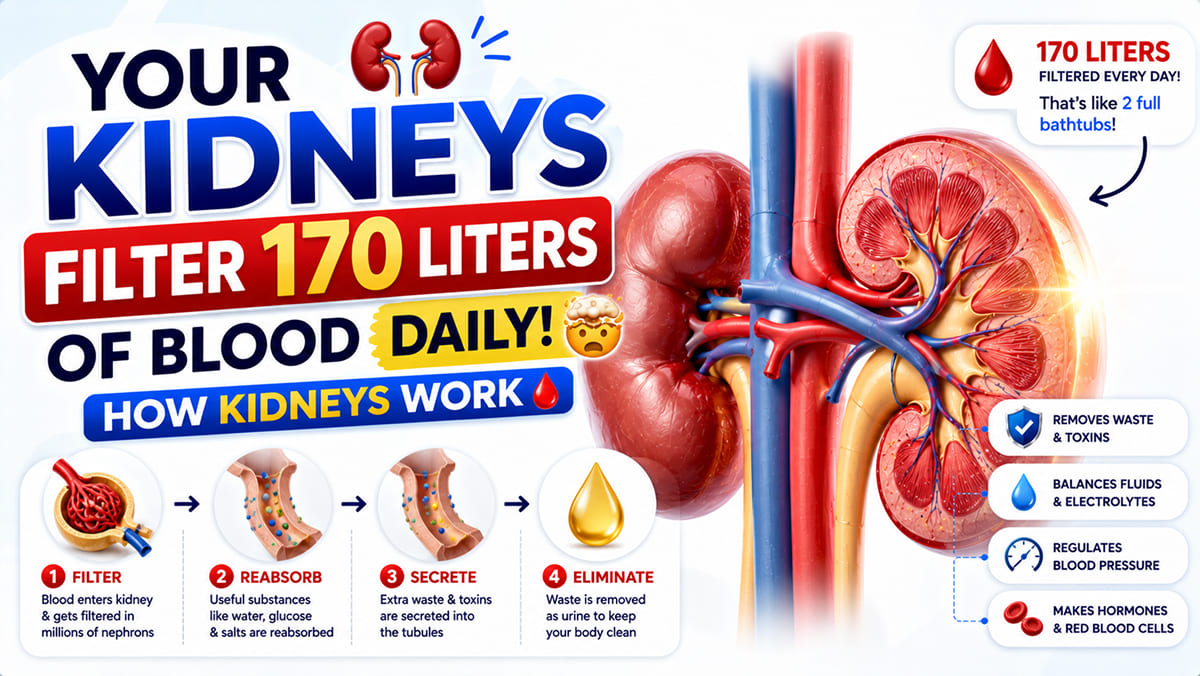
99% Blood Wapas Kahan Jata Hai? The Medical Miracle of How Kidneys Work
The human body is an absolute masterpiece of biological engineering, and nowhere is this more evident than in the renal system. Here is a mind-blowing medical fact that shocks most people: Your two kidneys filter approximately 170 to 180 liters of blood every single day! However, a healthy human adult only produces about 1 to 2 liters of urine daily. This raises a massive physiological question: If 180 liters of fluid are filtered out of your blood, where exactly does the remaining 99% go? And precisely peshab kaise banta hai (how is urine formed)?
To understand this remarkable fluid dynamic, we must dive deep into the microscopic anatomy of the kidneys. The kidneys are not just biological water filters; they are highly advanced chemical laboratories that regulate blood pressure, balance pH levels, and keep the human body in a constant state of homeostasis.
The Functional Unit of the Kidney: The Nephron
Your kidneys are two bean-shaped organs located against the back muscles in the upper abdominal area. If you were to slice a kidney open and look at it under a powerful microscope, you would see that it is made up of tiny, complex filtration tubes. These microscopic structures are called Nephrons.
The nephron is the functional unit of the kidney. Every single human kidney contains about 1 million to 1.2 million nephrons. Each nephron consists of a vascular component (blood vessels) and a tubular component. The biological process of making urine happens as blood passes through this microscopic assembly line in three distinct, highly regulated steps.
Step 1: Glomerular Filtration (The Biological Sieve)
The journey of urine formation begins when high-pressure blood from the heart enters the kidney via the Renal Artery. This artery branches into tiny arterioles that lead directly into the nephron. At the head of every nephron is a tiny, ball-like knot of capillaries called the Glomerulus. The glomerulus is completely encased in a cup-like structure called Bowman’s Capsule.
As blood rushes into the tight, narrow capillaries of the glomerulus, the extreme physical pressure forces liquid out of the blood and through the microscopic pores of the capillary walls. This process is called Glomerular Filtration.
- What gets filtered out? Water, glucose (sugar), amino acids, salts (sodium, potassium), and toxic metabolic waste products like urea and creatinine are squeezed out of the blood and fall into Bowman's capsule. This raw, watery liquid is now called the Filtrate.
- What stays in the blood? The pores in the glomerulus act like a highly specific biological sieve. Red Blood Cells (RBCs), White Blood Cells, and large plasma proteins are physically too big to fit through the microscopic holes. They safely bypass the filter and stay inside the bloodstream. (This is exactly why finding blood or protein in a urine test is a massive red flag, indicating that the glomerulus is damaged and leaking).
Step 2: Tubular Reabsorption (The 99% Mystery Solved)
Remember those 170 liters of filtrate we mentioned earlier? If your body actually urinated out 170 liters of fluid, you would die of severe dehydration and nutrient loss within minutes! This brings us to the most critical step of kidney function: Tubular Reabsorption.
As the raw filtrate leaves Bowman’s capsule, it travels down a long, twisting tube called the Renal Tubule (which includes the Proximal Convoluted Tubule, the Loop of Henle, and the Distal Convoluted Tubule). This long tube is tightly wrapped in a network of secondary blood vessels.
Here, the kidney performs an absolute biological miracle. It scans the fluid and selectively reabsorbs 99% of the water and 100% of the vital nutrients right back into the bloodstream!
- Glucose and Amino Acids: The body refuses to waste valuable energy. 100% of the glucose and amino acids are aggressively actively transported back into the blood. (If a person has severe Diabetes, the glucose levels are so high that the tubules get overwhelmed, and the excess sugar spills over into the urine).
- Water and Electrolytes: Based on your body's hydration level, hormones like ADH (Anti-Diuretic Hormone) tell the tubules exactly how much water and salt to suck back into the blood. If you are dehydrated, the kidney reabsorbs almost all the water, leaving you with very dark, highly concentrated urine.
Step 3: Tubular Secretion (Taking Out the Final Trash)
While reabsorption is pulling good things out of the tube and back into the blood, Tubular Secretion does the exact opposite. As the blood flows alongside the renal tubule, the body identifies large, toxic waste molecules that managed to escape the initial glomerular filtration.
The blood actively pumps excess potassium ions, hydrogen ions, specific drugs (like penicillin), and extra urea directly into the tubule. By secreting hydrogen ions, the kidney masterfully controls the Acid-Base (pH) balance of your entire bloodstream, ensuring your blood never becomes too acidic.
Step 4: Excretion (The Creation of Urine)
By the time the fluid reaches the very end of the nephron (the Collecting Duct), the 99% of vital water, sugar, and salts have been reclaimed by the body. The remaining 1% of the fluid is a highly concentrated, toxic mixture of urea, excess salts, water, and metabolic waste. This final fluid is officially called Urine (Peshab).
The urine drips from the millions of collecting ducts into the center of the kidney (the renal pelvis), travels down two long tubes called the Ureters, and fills up the Urinary Bladder. Once the bladder is full, nerves signal your brain that it is time to urinate, safely expelling the toxins from your body.
Beyond Filtration: The Hidden Superpowers of the Kidneys
While making urine is their most famous job, the kidneys are actually multi-functional endocrine organs. They have three other critical superpowers that keep you alive:
- Blood Pressure Regulation: If your blood pressure drops too low, the kidneys instantly release an enzyme called Renin. This triggers a massive systemic hormonal cascade (the RAAS system) that aggressively tightens your blood vessels and raises your blood pressure back to normal.
- Red Blood Cell Production: If the kidneys detect that your blood's oxygen level is too low, they secrete a hormone called Erythropoietin (EPO). This hormone travels directly to your bone marrow and commands it to manufacture millions of new Red Blood Cells.
- Vitamin D Activation: The vitamin D you get from the sun or food is biologically inactive. The kidneys perform the final chemical conversion (hydroxylation) that turns it into active Vitamin D (Calcitriol), allowing your intestines to absorb calcium and keeping your bones strong.
The next time you drink a glass of water, take a moment to appreciate the millions of microscopic nephrons working silently inside you. They are constantly filtering, reabsorbing, and balancing your blood chemistry with absolute perfection, proving that the human kidney is far more than just a waste-disposal system.