
Agar brain me pain nahi hota, toh sir dard kyu hota hai?
Agar Brain Me Pain Nahi Hota, Toh Sir Dard Kyu Hota Hai? The Science of Headaches It is one of the most fascinating paradoxes in human biology: When you suffer fr...
Medically Reviewed By
Medscope Editorial Team Verified
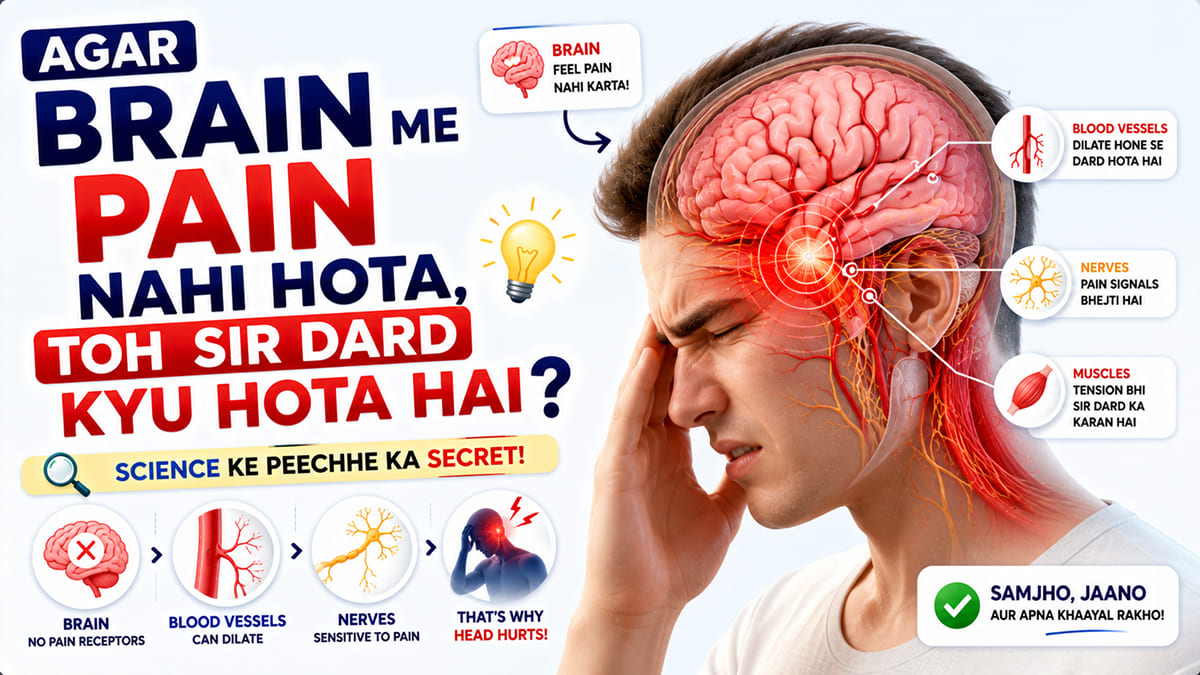
Agar Brain Me Pain Nahi Hota, Toh Sir Dard Kyu Hota Hai? The Science of Headaches
It is one of the most fascinating paradoxes in human biology: When you suffer from a severe headache, it feels like your actual brain is throbbing in pain. However, neurosurgeons routinely perform open-brain surgeries on patients who are completely awake, talking, and playing instruments while the surgeon cuts into their brain tissue. How is this possible? Because the human brain is completely incapable of feeling pain.
This raises a massive physiological question: If the brain has absolutely no pain receptors, then where exactly is the pain of a headache coming from? To understand this medical mystery, we must take a deep dive into the anatomy of the human head, the nervous system, and the vascular changes that trigger the agony of a headache.
The Absence of Nociceptors: Why the Brain Feels No Pain
To understand why the brain cannot feel pain, we first need to understand how pain works in the rest of the body. Your skin, muscles, joints, and internal organs are packed with millions of microscopic sensory nerve endings called Nociceptors (pain receptors). If you touch a hot stove or cut your finger, these nociceptors instantly fire an electrical danger signal up your spinal cord and into your brain. The brain receives the signal, translates it, and makes you feel the sensation of "pain."
However, the brain tissue itself (the gray and white matter) has zero nociceptors. The brain is the ultimate supercomputer that processes pain signals from the rest of the body, but it has no biological mechanism to feel pain itself. Therefore, during a headache, your actual brain is not hurting at all.
If Not the Brain, Then What Actually Hurts?
If the brain tissue isn't hurting, what is causing that splitting pain in your head? The answer lies in the structures that surround, protect, and feed the brain. While the brain has no pain receptors, the surrounding anatomy is heavily packed with highly sensitive nociceptors. During a headache, the pain originates from these specific areas:
- The Blood Vessels: The large arteries and veins that supply oxygen-rich blood to the brain and scalp are extremely sensitive to pressure and stretching.
- The Meninges: The brain is wrapped in three protective layers of tissue called the meninges (the Pia mater, Arachnoid mater, and Dura mater). The outermost layer, the Dura mater, is packed with pain-sensing nerves.
- The Muscles and Nerves: The muscles of your neck, scalp, and jaw, as well as the major cranial nerves in your face, can become tense, inflamed, and highly painful.
The Star of the Show: The Trigeminal Nerve
The primary biological culprit behind most headaches is the Trigeminal Nerve (Cranial Nerve V). This is the largest and most complex nerve in your head, responsible for transmitting sensations from your face, eyes, sinuses, and the meninges directly to your brain.
When you experience triggers like severe stress, lack of sleep, heavy dehydration, or extreme screen time, your body reacts chemically. The blood vessels surrounding your brain and skull begin to rapidly expand and swell. This physiological process is called Vasodilation.
As these blood vessels massively dilate, they physically stretch the sensitive meninges and put immense mechanical pressure directly on the Trigeminal Nerve. The Trigeminal nerve becomes hyper-activated and irritated. It starts firing massive "danger" signals back into the brain. The brain processes these signals and projects the feeling of pain over your entire head. You are not feeling brain pain; you are feeling swollen blood vessels crushing a major facial nerve!
Types of Headaches and Their Unique Pathophysiology
Because the structures surrounding the brain are so complex, there are different types of headaches, each with a very different biological cause:
1. Tension Headaches (The Muscle Squeezer)
This is the most common type of headache in the world. It feels like a tight, squeezing rubber band is wrapped completely around your forehead. Tension headaches are not primarily vascular; they are muscular. When you take on too much mental stress, sit with bad posture looking at a laptop, or clench your jaw, the muscles in your neck (trapezius), scalp, and forehead become chronically tight and spasm. The nociceptors in these muscles cry out in pain, sending signals to the brain.
2. Migraines (The Neurovascular Storm)
A migraine is far more severe than a normal headache; it is a complex neurovascular event. In a migraine, the sensory nerves become hyper-excitable. The Trigeminal nerve releases inflammatory chemicals (like CGRP - Calcitonin Gene-Related Peptide) directly onto the blood vessels covering the brain. This causes massive swelling, extreme throbbing pain (usually on just one side of the head), severe nausea, and a high sensitivity to light and sound (photophobia and phonophobia).
3. Dehydration Headaches
Your brain is made of approximately 73% water. When you are severely dehydrated, your blood volume drops, and your brain tissue actually shrinks slightly, pulling away from the skull. This physically stretches the pain-sensitive meninges, causing a severe, dull ache across the entire head. This is the exact mechanism behind a "hangover" headache after drinking too much alcohol, which is a powerful diuretic that dehydrates the body.
How to Stop a Normal Headache Fast
Understanding the biology of a headache reveals exactly how to cure it quickly without always relying on heavy painkillers:
- Massive Hydration: If the cause is dehydration, drinking 2 to 3 large glasses of water will restore your blood volume, re-plump the brain tissue, and relieve the mechanical pulling on the meninges.
- Rest in a Dark Room: If your blood vessels are dilated due to stress or screen-induced eye strain, resting in a cool, dark environment removes sensory input. This allows the nervous system to calm down, signaling the blood vessels to constrict (shrink) back to their normal size, relieving the pressure on the Trigeminal nerve.
- Caffeine: A small cup of black coffee can often cure a mild headache. Caffeine is a known vasoconstrictor. It forces the swollen, dilated blood vessels in your head to narrow and tighten, immediately removing the pressure from the surrounding nerves.
The next time your head is throbbing, you can rest easy knowing your brain is perfectly safe. It is simply your blood vessels, muscles, and the mighty Trigeminal nerve sending a loud physiological message that your body needs hydration, less screen time, and a well-deserved break.