
Blood Group Test Kaise Hota Hai? | Khoon Ki 3 Boond Se Blood Group Kaise Pata Chalta Hai?
Blood Group Test Kaise Hota Hai? Khoon Ki 3 Boond Se Blood Group Kaise Pata Chalta Hai? Imagine walking into a pathology lab. The lab technician takes a tiny need...
Medically Reviewed By
Medscope Editorial Team Verified
Blood Group Test Kaise Hota Hai? Khoon Ki 3 Boond Se Blood Group Kaise Pata Chalta Hai?
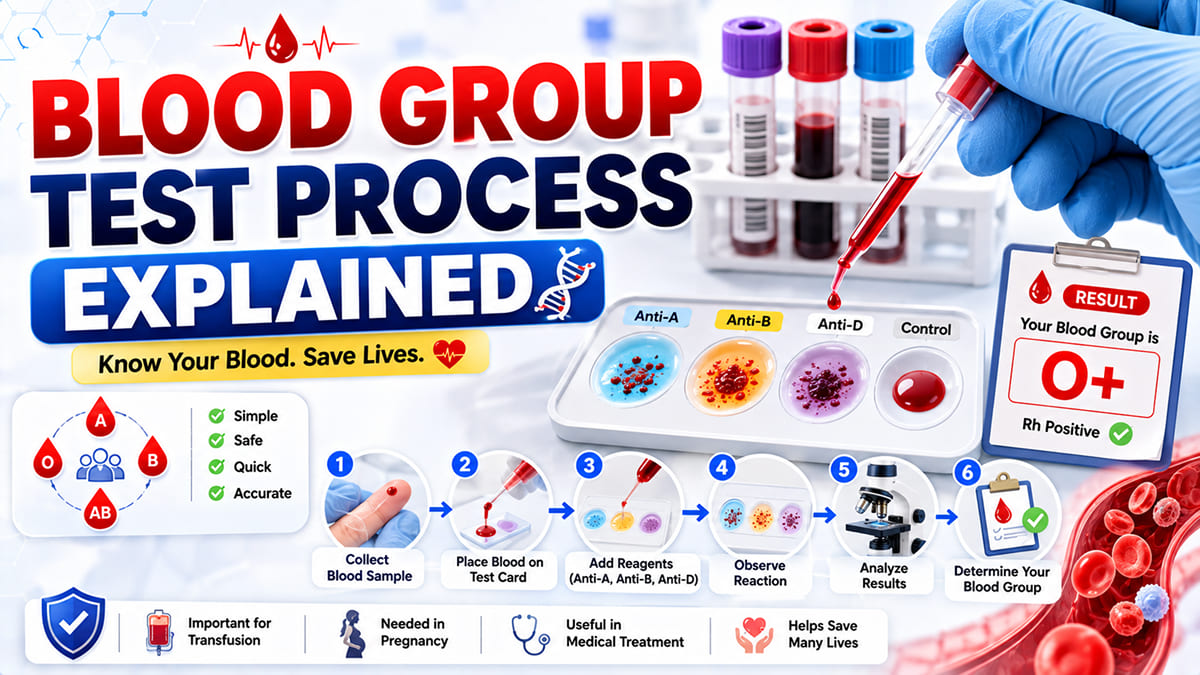
Imagine walking into a pathology lab. The lab technician takes a tiny needle, pricks your finger, and places just three small drops of your blood on a plain glass slide. They add a few drops of colored liquids, mix them with a toothpick, and within 60 seconds, they confidently tell you your exact blood type. To a normal person, this looks like pure magic. But in the medical world, this is a brilliant display of microscopic biochemistry.
How can just three drops of blood reveal your entire ABO and Rh blood profile? This simple, rapid test saves millions of lives every single day by preventing fatal blood transfusion errors. Let us dive deep into the science of blood typing and decode the exact physiological logic behind how doctors determine your blood group.
The Biological Secret: Antigens and Agglutination
Before we understand the test, we must understand what is actually on the surface of your blood. Your Red Blood Cells (RBCs) are covered in tiny protein markers called Antigens. Think of these antigens as your blood's ID cards.
- If you have Blood Group A, your cells have 'A' Antigens.
- If you have Blood Group B, your cells have 'B' Antigens.
- If you have Blood Group AB, your cells have both 'A' and 'B' Antigens.
- If you have Blood Group O, your cells have Zero Antigens (a blank surface).
To find out which "ID card" your blood has, the laboratory uses special chemical drops called Reagents (Antibodies). When a specific antibody meets its matching antigen, it attacks it. This attack causes the red blood cells to stick together and physically clump up. In medical terminology, this clumping or "khoon ka phatna" is called Agglutination. This clumping is the exact visual clue the doctor is looking for!
The Clinical Setup: The 3 Magic Chemical Drops
When the technician places three drops of your blood on the glass slide, they add three distinct, universally color-coded chemical reagents to them. Each reagent has a very specific job:
- Drop 1 gets Anti-A Reagent (Blue Color): This chemical is designed to search and attack only the 'A' antigens.
- Drop 2 gets Anti-B Reagent (Yellow Color): This chemical is designed to search and attack only the 'B' antigens.
- Drop 3 gets Anti-D Reagent (Clear/Colorless): This chemical searches for the Rh Factor, which determines if your blood is Positive (+) or Negative (-).
After adding these chemicals, the technician gently mixes each drop with a separate sterile stick and waits for about a minute. Now, the magic of science reveals itself.
Decoding the Matrix: How to Read the ABO Blood Group
To determine your primary blood group (A, B, AB, or O), the doctor only looks at the first two drops (the Blue Anti-A and the Yellow Anti-B). Here is the exact logic they use:
1. Blood Group A
If the first drop (Anti-A) clumps and splits (phat jati hai), but the second drop remains completely smooth liquid, it means the chemical successfully found 'A' antigens. Your blood group is A.
2. Blood Group B
If the first drop remains smooth liquid, but the second drop (Anti-B) clumps and splits, it means the chemical found 'B' antigens. Your blood group is B.
3. Blood Group AB
What if your blood has both ID cards? If both the first drop and the second drop violently clump up, it means the blood has both A and B antigens present on its surface. Your blood group is AB.
4. Blood Group O
What if your red blood cells have a completely smooth, blank surface with no antigens? Because there is nothing for the chemicals to attack, neither the first drop nor the second drop will clump. Both drops will remain perfectly smooth red liquid. This empty state means your blood group is O.
The Final Step: Determining Positive (+) or Negative (-)
Once the ABO group is decided, the doctor looks exclusively at the Third Drop (Anti-D). This drop is the ultimate decider of your Rh Factor.
- Positive (+): If the third drop clumps (khoon phat gaya), it means the Rh protein is present on your blood cells. You are Rh-Positive.
- Negative (-): If the third drop remains perfectly smooth and un-clumped, it means you do not have the Rh protein. You are Rh-Negative.
Let's Practice: Real-World Clinical Examples
To completely master this concept, let us look at two real-world examples as shown in the 3D animation:
Example 1: You mix the chemicals. Drop 1 is smooth. Drop 2 is smooth. (Since neither clumped, the group is O). But Drop 3 clumps up and splits! (This means Positive). Therefore, your final blood group is O Positive (O+).
Example 2: You mix the chemicals. Drop 1 clumps up. Drop 2 also clumps up. (Since both clumped, the group is AB). However, Drop 3 remains completely smooth liquid. (This means Negative). Therefore, your final blood group is AB Negative (AB-).
Why is this 60-Second Test So Crucial?
This microscopic antigen-antibody reaction might seem like a simple high school biology experiment, but it is the foundation of emergency medicine. If a doctor skips this test and gives an A+ patient a bag of B+ blood, the patient's immune system will instantly attack the donor blood. Massive internal clumping (agglutination) will occur inside the patient's veins, leading to immediate kidney failure, hypovolemic shock, and rapid death.
Thanks to the brilliant discovery of these specific reagents, medical professionals can guarantee 100% safe blood transfusions, allowing those three tiny drops of blood to save countless lives every single day.