
Body Me Oxygen Kaise Kaam Karti Hai? | The Amazing Journey of Oxygen
The Amazing Journey of Oxygen: How Your Body Uses Every Breath Oxygen is the single most critical element for human survival. A human being can survive for weeks...
Medically Reviewed By
Medscope Editorial Team Verified
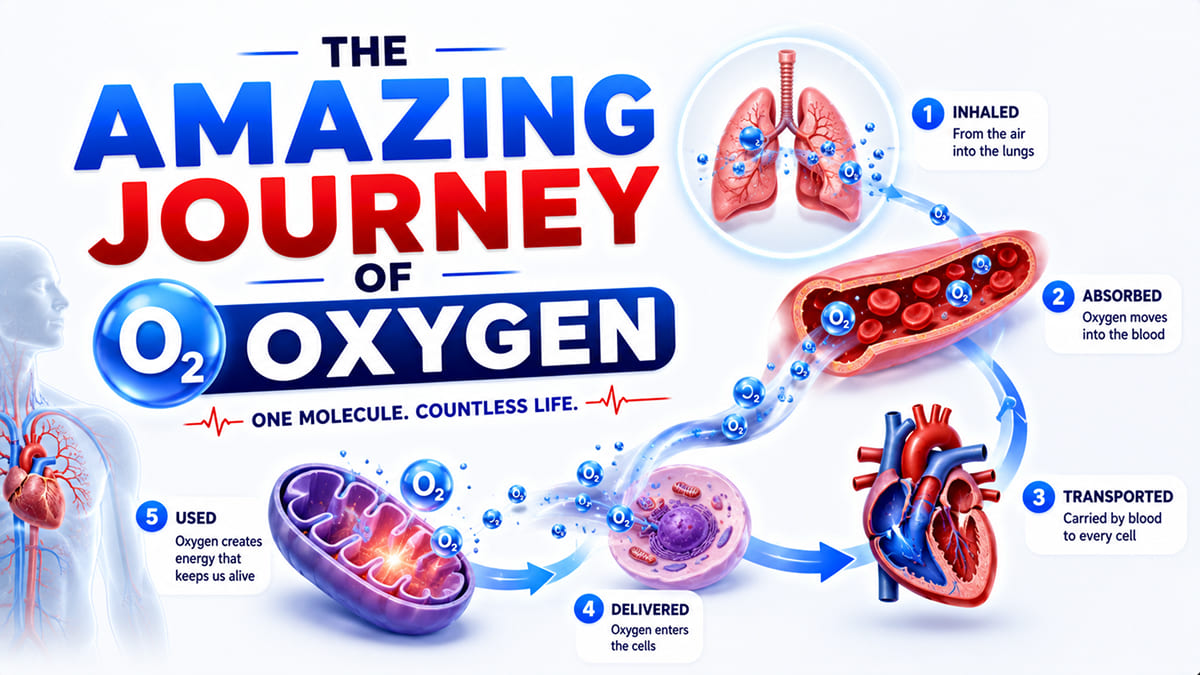
The Amazing Journey of Oxygen: How Your Body Uses Every Breath
Oxygen is the single most critical element for human survival. A human being can survive for weeks without food, a few days without water, but only a few minutes without oxygen. But what exactly does oxygen do inside the body? Why is it so biologically crucial? The answer lies in a fascinating physiological journey that starts from the outside air, travels through your respiratory system, enters your bloodstream, and finally reaches deep into the microscopic mitochondria of every single cell in your body.
For medical students, nursing professionals, and anyone curious about human biology, understanding this pathway is essential. Let’s break down the incredible journey of oxygen step-by-step, exploring how your body turns the air you breathe into the cellular energy that keeps you alive.
Step 1: The Respiratory Pathway (Inhalation)
The journey begins the moment you take a breath (inspiration). When you inhale, the diaphragm muscle contracts and pulls downward, creating a negative pressure vacuum in your chest cavity that sucks air into your lungs.
- The Upper Airway: Air enters through your nasal cavity or mouth. The nose acts as a biological air conditioner—it warms the air to body temperature, humidifies it, and uses tiny hairs (cilia) and sticky mucus to filter out dust, bacteria, and allergens.
- The Trachea and Bronchi: The clean, warm air travels down your pharynx (throat), past the larynx (voice box), and into the trachea (windpipe). The trachea then splits into two main branches called the right and left mainstem bronchi, which enter the lungs.
- The Bronchioles and Alveoli: Inside the lungs, these bronchi branch out like the roots of a tree into thousands of microscopic tubes called bronchioles. At the very end of these tubes are millions of tiny, balloon-like air sacs called Alveoli. This is the ultimate destination for the inhaled air.
Step 2: External Respiration (The Alveolar Gas Exchange)
The alveoli are where the magic of "external respiration" happens. The walls of the alveoli are incredibly thin—literally only one cell thick (squamous epithelium). They are completely wrapped in a dense network of tiny blood vessels called pulmonary capillaries.
When you inhale, the alveoli fill with oxygen-rich air. Meanwhile, the blood flowing through the capillaries is oxygen-poor but heavily loaded with Carbon Dioxide (CO2), a toxic waste product. Because of a fundamental physiological principle called a concentration gradient, gases naturally move from an area of high concentration to an area of low concentration.
Without requiring any extra energy, the oxygen instantly diffuses straight through the extremely thin alveolar membrane and into the blood. Simultaneously, the carbon dioxide diffuses from the blood back into the alveoli, waiting to be exhaled. This exact biological crossover point is the most critical function of your lungs.
Step 3: The Transport System (Hemoglobin and The Heart)
Once the oxygen crosses into the bloodstream, it needs a vehicle to travel through the miles of blood vessels in your body. It enters the Red Blood Cells (Erythrocytes). Inside every red blood cell are millions of molecules of a complex, iron-rich protein called Hemoglobin.
Oxygen molecules strongly bind to the iron in hemoglobin. This binding process physically changes the shape of the protein and turns the blood a bright, vibrant red (creating a compound called Oxyhemoglobin). Now fully loaded with oxygen cargo, this blood travels via the pulmonary veins back to the left side of the heart.
The heart acts as a massive, tireless muscular pump. The powerful left ventricle contracts, blasting this oxygen-rich blood out through the Aorta (the body's largest artery). From the aorta, the blood is rapidly distributed through a vast network of arteries and arterioles to every organ, tissue, and muscle in the body.
Step 4: Cellular Respiration (The Ultimate Goal)
The ultimate destination for oxygen is not just the blood—it is the cells. The arteries eventually branch into microscopic systemic capillaries that feed individual tissue cells. Because the cells have been using up oxygen, their internal oxygen concentration is very low. Once again, using the concentration gradient, oxygen detaches from the hemoglobin, diffuses out of the blood, and enters the tissue cells.
Here, the oxygen enters the Mitochondria, famously known as the "powerhouses" of the cell. Why do we need oxygen here? Because of a vital biochemical process called Cellular Respiration.
Our cells run on a biological battery fuel called ATP (Adenosine Triphosphate). To make ATP, the mitochondria require two primary ingredients: Glucose (sugar from the food you eat) and Oxygen. In the presence of oxygen (aerobic metabolism), the mitochondria efficiently burn the glucose, producing a massive amount of ATP energy (36 to 38 ATP molecules per glucose molecule). Without oxygen (anaerobic metabolism), the cells can barely produce any energy, leading to rapid cell death.
Step 5: The Return Journey (Removing the Waste)
As a natural byproduct of burning glucose to create ATP, the cells generate Carbon Dioxide (CO2) and water. CO2 is highly toxic if it builds up in the body because it dissolves in the blood to form carbonic acid, making the blood dangerously acidic (acidosis).
The CO2 diffuses out of the cells and back into the bloodstream. It is carried back through the venous system (veins) to the right side of the heart. The right ventricle then pumps this waste-filled blood back to the lungs. Back at the alveoli, the CO2 crosses over into the lung sacs and is expelled from your body the exact moment you exhale. This complete, flawless cycle happens effortlessly over 20,000 times a day.
Clinical Relevance: When the Journey Fails (Hypoxia)
For healthcare professionals, understanding this journey is absolute paramount. When this pathway fails at any point, the body experiences Hypoxia (severe oxygen starvation at the tissue level). This can happen for several reasons:
- Airway Obstruction: Choking or severe asthma prevents air from reaching the alveoli.
- Alveolar Damage: Fluid in the lungs (Pneumonia or Pulmonary Edema) blocks the gas exchange.
- Transport Failure: A lack of red blood cells (Severe Anemia) means there are no "vehicles" to carry the oxygen.
- Pump Failure: Congestive Heart Failure prevents the oxygenated blood from circulating fast enough.
This is precisely why tracking a patient's oxygen saturation (SpO2) using a pulse oximeter is one of the most vital clinical assessments in emergency medicine and intensive care. By securing the airway and giving supplemental oxygen, medical professionals ensure this amazing journey never stops.