
Dengue Me Platelets Kyu Girte Hai? | How Dengue Virus Attacks Your Body
Dengue Me Platelets Kyu Girte Hai? How the Dengue Virus Attacks Your Body Can a tiny insect, weighing less than a fraction of a gram, bring a perfectly healthy hu...
Medically Reviewed By
Medscope Editorial Team Verified
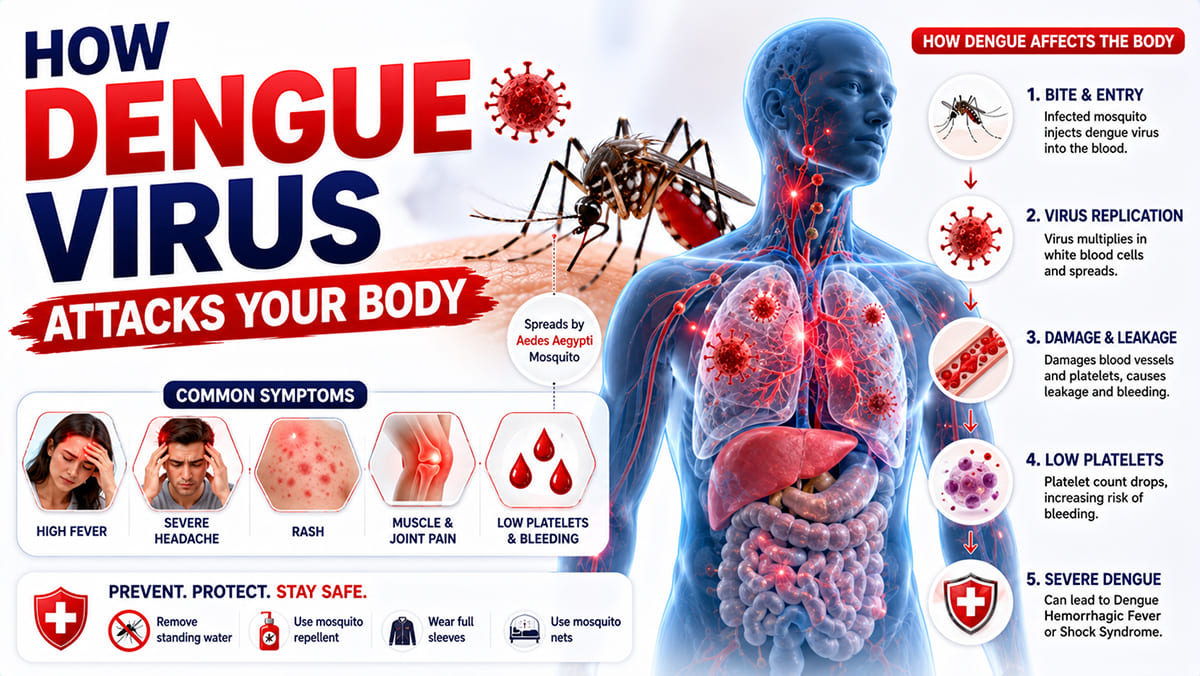
Dengue Me Platelets Kyu Girte Hai? How the Dengue Virus Attacks Your Body
Can a tiny insect, weighing less than a fraction of a gram, bring a perfectly healthy human body to the brink of death? The terrifying answer is yes. Every year, millions of people across the globe are struck down by a microscopic viral invader that causes high fever, agonizing pain, and a terrifying drop in their blood's clotting ability. We know this disease commonly as Dengue Fever.
When someone is diagnosed with Dengue, the absolute first question the doctor and the family ask is, "What is the platelet count?" But why does this specific virus cause our platelets to crash so violently? Why does it cause such excruciating pain that doctors refer to it as "Breakbone Fever"? To understand the true destructive power of the Dengue virus, we must take a 3D medical journey deep inside the human bloodstream and witness exactly how this microscopic enemy wages war against our immune system.
The Vector: The Aedes Aegypti Mosquito
The Dengue virus cannot survive outside a host and cannot fly through the air. It requires a highly efficient biological delivery system. This delivery system is the Female Aedes aegypti mosquito. Unlike the malaria mosquito which usually bites at night, the Aedes mosquito is a daytime feeder and aggressively breeds in clean, stagnant water inside and around our homes.
When an infected Aedes mosquito lands on your skin and pierces a capillary to drink your blood, she simultaneously injects a tiny amount of her saliva into your bloodstream. Hidden inside this microscopic drop of saliva are thousands of live Dengue viruses.
Phase 1: The Hijack of the Immune System
The moment the Dengue virus enters your blood, your immune system's security guards—the White Blood Cells (WBCs)—immediately detect the foreign invader. Cells like Macrophages and Dendritic cells rush to the site of the bite and literally swallow the virus to destroy it.
However, this is exactly what the Dengue virus wants! The virus operates like a biological Trojan Horse. Instead of dying inside the White Blood Cell, the virus hijacks the cell's internal machinery. It reprograms the DNA of your immune cells, turning your own defenders into massive viral cloning factories.
The virus rapidly replicates inside the White Blood Cells until the cells become so bloated with new viruses that they violently burst open (Lysis). This releases tens of thousands of newly cloned Dengue viruses directly into your main bloodstream, allowing them to rapidly infect organs throughout your entire body.
The Symptoms: Why is it Called "Breakbone Fever"?
As millions of infected White Blood Cells burst and die, your immune system goes into a state of absolute panic. It releases massive amounts of inflammatory chemicals known as Cytokines into your blood (a Cytokine Storm).
This massive chemical overload travels straight to the Hypothalamus in your brain, causing your core body temperature to violently spike, often reaching a dangerously high 104°F (40°C). The cytokines also trigger severe inflammation in your muscles and joints. The pain is so deep, throbbing, and excruciating that patients feel as if their actual bones are being crushed or broken from the inside out, which is exactly why medical professionals historically named Dengue "Breakbone Fever." Additional symptoms include severe retro-orbital pain (pain directly behind the eyes), extreme fatigue, and severe nausea.
The Core Question: Why Do Platelets Drop? (Thrombocytopenia)
In a healthy human, a normal platelet count ranges from 150,000 to 450,000 per microliter of blood. Platelets are tiny cell fragments that act as your body's biological glue; they clot your blood and stop you from bleeding. In severe Dengue, this number can dangerously crash below 20,000. Why does this happen? The virus attacks platelets using a deadly two-step strategy:
1. Bone Marrow Suppression
Platelets are not made in the blood; they are manufactured deep inside the hollow centers of your large bones, in a spongy tissue called the Bone Marrow. Specifically, they are produced by giant cells called Megakaryocytes. The Dengue virus travels through the blood and physically infects the bone marrow. It suppresses and damages the Megakaryocytes, bringing the body's entire platelet-manufacturing factory to a sudden, grinding halt. Your body simply stops making new platelets.
2. Autoimmune Destruction in the Blood
While the bone marrow is shut down, a second disaster happens in the bloodstream. The Dengue virus physically binds to the outer surface of your existing, healthy platelets. Your confused immune system sees the virus attached to the platelet and assumes the platelet itself is the enemy. Your body unleashes antibodies that aggressively attack and destroy its own remaining platelets. Because the factory is shut down and the existing supply is being actively destroyed, the platelet count crashes violently.
The Ultimate Danger: Plasma Leakage and Dengue Shock Syndrome
A low platelet count is dangerous because it leads to internal bleeding (Hemorrhagic Fever), but there is an even greater threat: Plasma Leakage.
The intense cytokine storm caused by the virus heavily damages the Endothelial cells—the microscopic inner lining of your blood vessels. This damage causes the walls of your blood vessels to become porous and leaky, like a microscopic sieve.
The liquid portion of your blood (Plasma) begins to physically leak out of your blood vessels and spills into your chest cavity (lungs) and abdomen. Because the liquid is leaking out, your overall blood volume crashes dramatically. Without enough blood volume to pump, your blood pressure plummets to fatal levels. This catastrophic drop in blood pressure is called Dengue Shock Syndrome (DSS). If the brain and internal organs are deprived of oxygen-rich blood due to this shock, it can rapidly lead to multiple organ failure and death.
Medical Treatment and Prevention: How to Survive Dengue
Here is a harsh medical reality: Currently, there is absolutely no specific antiviral medicine and no widely available cure for Dengue.
So, how do doctors save lives? The treatment is entirely Supportive Care, and the absolute most critical intervention is Massive Hydration. Because the virus causes Plasma Leakage, doctors must aggressively replace the lost fluid using Intravenous (IV) drips and massive amounts of oral fluids (like ORS, coconut water, and fresh juices). By keeping the blood volume high, doctors prevent the patient from entering Dengue Shock Syndrome, buying enough time for the patient's own immune system to defeat the virus and for the bone marrow to start producing platelets again.
Because there is no cure, Prevention is the only true defense. The Aedes mosquito breeds exclusively in clean, stagnant water. To protect yourself and your family, you must aggressively empty, cover, or throw away any containers holding standing water around your home (such as old tires, flower pots, and open buckets). Using strong mosquito repellents and sleeping under nets is non-negotiable during the monsoon season.
Dengue is a terrifying biological invader, but with immediate medical attention, strict hydration protocols, and aggressive mosquito control, it is a battle that the human body can win.
For more fascinating 3D anatomical journeys and deep dives into medical science, make sure to subscribe to Medscope Visuals on YouTube! Let us know in the comments which virus, disease, or bodily function you want us to explain in 3D next!