
Geele Haathon Se Current 100x Zyada Kyu Lagta Hai 3D Animation
The Lethal Danger of Water and Electricity From a very young age, we are strictly taught never to touch a light switch, a power plug, or an electrical appliance w...
Medically Reviewed By
Medscope Editorial Team Verified
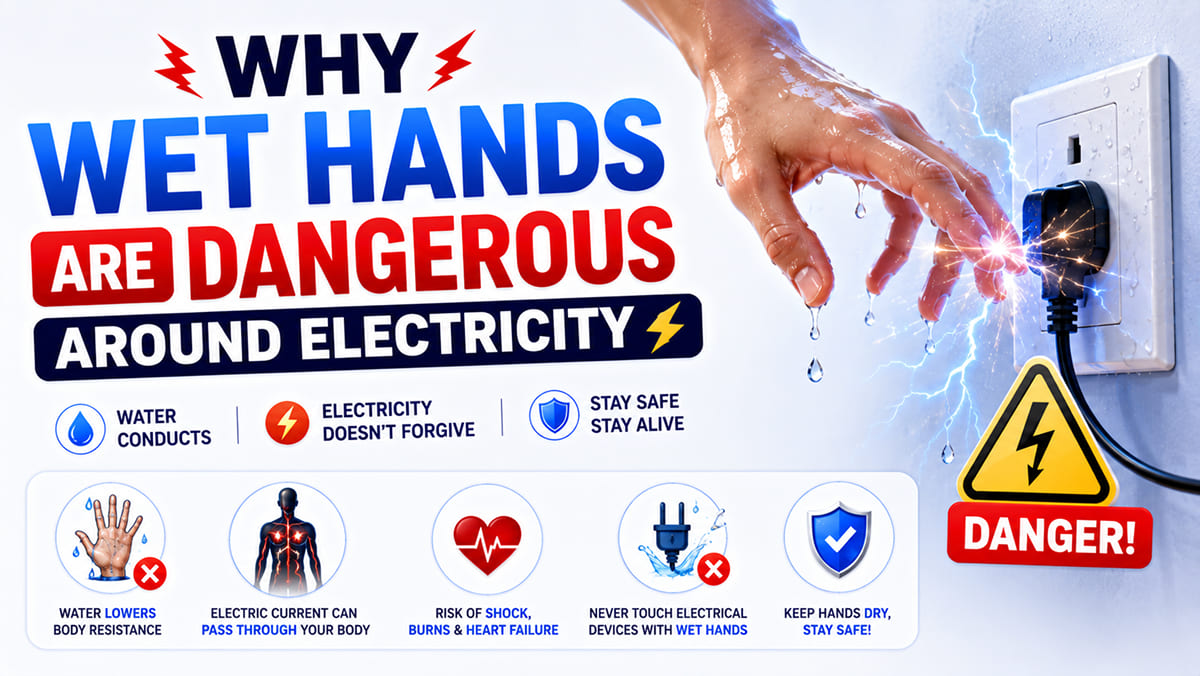
The Lethal Danger of Water and Electricity
From a very young age, we are strictly taught never to touch a light switch, a power plug, or an electrical appliance with wet hands. But from the perspective of physics and human physiology, why is this rule so incredibly important? Why does a minor, tingling static shock turn into a highly lethal electrocution just because your hands are wet? The scientific answer lies in the fundamental concept of Electrical Resistance and how the human body reacts to alternating current (AC).
Understanding Ohm's Law and Skin Resistance
Electricity is fundamentally lazy; it always seeks the path of least resistance to reach the ground. According to Ohm's Law (Current = Voltage / Resistance), the amount of electrical current that flows through any object depends heavily on how much that object resists the flow.
The inside of the human body is essentially a bag of salty water, blood, and minerals—all of which conduct electricity exceptionally well. However, our ultimate biological shield is the outermost, dead layer of our skin known as the Stratum Corneum.
- Dry Skin (The Ultimate Insulator): Completely dry, calloused skin is a fantastic electrical insulator. It has a massive electrical resistance of approximately 100,000 ohms. If you accidentally touch a standard 120V or 240V household wire with completely dry hands, this high resistance blocks most of the electricity. The actual current entering your internal organs remains relatively low, usually resulting in a painful, but non-lethal, shock.
- Wet Skin (The Conductor): Water—especially tap water and human sweat, which contain dissolved salt ions (sodium and chloride)—is an excellent conductor of electricity. When your hands are wet, the moisture rapidly permeates the dead skin cells. This completely destroys the skin's electrical resistance, dropping it from 100,000 ohms down to as low as 1,000 ohms. This is a 100-fold decrease in your body's natural defense!
The Physiological Effects of a Wet Shock
Because the resistance of wet skin is 100 times lower, touching a live wire allows a massive, catastrophic surge of electrical current to bypass the skin and enter your internal organs directly. Once the electricity is inside, it targets your nervous system and your muscles.
The human heart relies on very tiny, precise electrical impulses (generated by the SA node) to beat rhythmically. If an external AC current from a wet wall socket travels through your arm and crosses your chest cavity, it completely overrides the heart's natural pacemaker.
A current of just 50 to 100 milliamperes (mA)—which easily enters the body when wet—is enough to throw the heart into a lethal arrhythmia called Ventricular Fibrillation (V-Fib). During V-Fib, the heart muscle stops pumping blood and begins to quiver uselessly. Without immediate CPR and a defibrillator, this leads to rapid cardiac arrest and death within minutes.
The "No-Let-Go" Threshold (Tetany)
Another terrifying physiological effect of electricity is muscle tetany. Electricity causes muscles to violently contract. Because the flexor muscles in your forearm (which close your hand) are much stronger than the extensor muscles (which open your hand), an electric shock forces your hand to instantly clamp down into a tight fist. If you grab a live wire with a wet hand, the current locks your muscles, making it biologically impossible for you to let go, drastically increasing the duration and lethality of the shock.