
Haath-Pair Me Jhanjhanahat Kyu Hoti Hai? | Vitamin B12 Deficiency
Haath-Pair Me Jhanjhanahat Kyu Hoti Hai? The Science of Vitamin B12 Deficiency Have you ever experienced a strange, uncomfortable sensation of "pins and needles"...
Medically Reviewed By
Medscope Editorial Team Verified
Haath-Pair Me Jhanjhanahat Kyu Hoti Hai? The Science of Vitamin B12 Deficiency
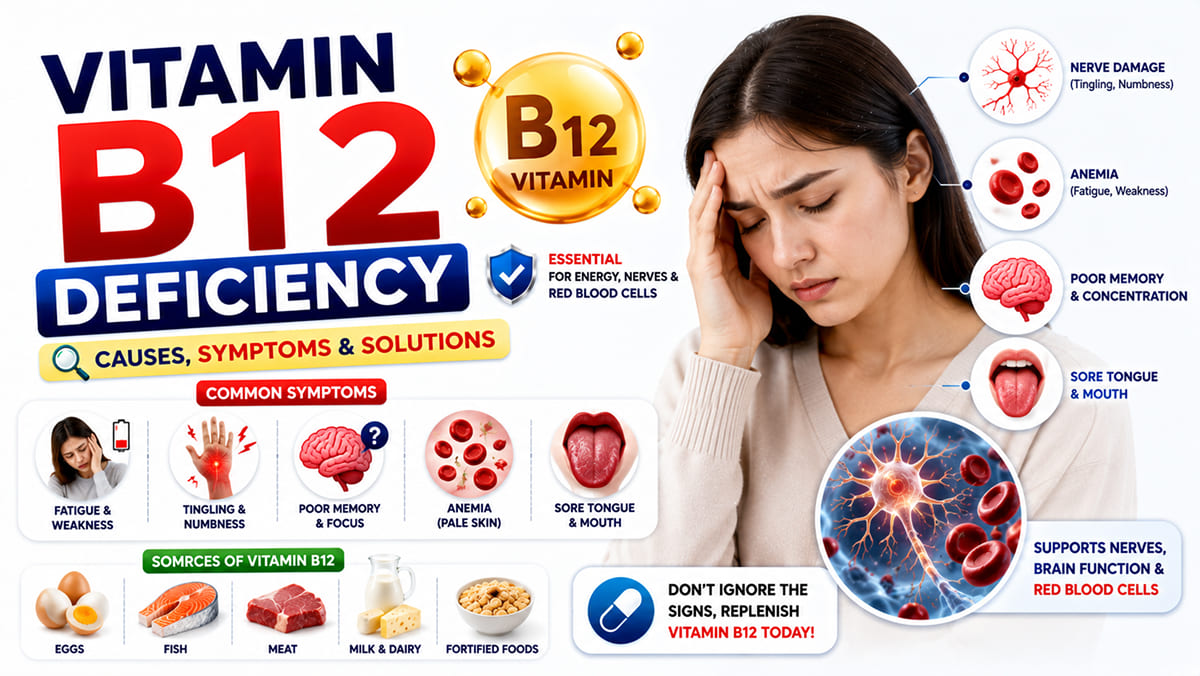
Have you ever experienced a strange, uncomfortable sensation of "pins and needles" in your hands or feet? In common terms, we call this jhanjhanahat or numbness. Many people ignore this feeling, assuming they just slept in an awkward position or sat cross-legged for too long. However, if this tingling sensation happens frequently without any physical pressure on your limbs, your body is sending you a terrifying neurological warning.
This persistent numbness is one of the primary symptoms of Vitamin B12 Deficiency. Here is a shocking medical fact: Your liver is an incredible storage organ. It can store enough Vitamin B12 to last your body for 3 to 5 entire years! Therefore, if you are finally starting to feel the symptoms of tingling and weakness today, it means your internal stores have been completely empty for a very long time, and permanent nerve damage may have already begun.
The 3 Biological Superpowers of Vitamin B12
Vitamin B12 (medically known as Cobalamin) is a water-soluble vitamin that acts as a fundamental building block for human life. Your body absolutely cannot survive without it, as it performs three highly critical physiological functions:
- Myelin Synthesis (Protecting the Nerves): B12 is mandatory for the production of Myelin, the protective covering of your nervous system.
- DNA Synthesis: Every single time a cell divides in your body, it needs to copy its DNA. Vitamin B12 acts as a crucial cofactor in this genetic replication process.
- Red Blood Cell (RBC) Production: Your bone marrow requires massive amounts of B12 to manufacture healthy, mature red blood cells that carry oxygen throughout your body.
The Neurological Nightmare: Why the Tingling Happens?
To understand the "jhanjhanahat" (tingling), we must look at the microscopic anatomy of your nervous system. Your nerves are basically biological electrical wires that carry signals from your brain to your hands and feet.
Just like a copper electrical wire in your house is wrapped in a plastic rubber coating to prevent short circuits, your delicate nerve fibers (axons) are wrapped in a thick, fatty, protective layer called the Myelin Sheath. Vitamin B12 is the primary ingredient required to build and maintain this myelin.
When your body runs out of Vitamin B12, the myelin sheath begins to slowly dissolve and break down. This terrifying medical condition is called Subacute Combined Degeneration of the Spinal Cord. Without the protective myelin coating, the raw nerve fibers are exposed. The electrical signals traveling from your brain to your feet begin to "short-circuit" and misfire. This neurological short-circuit is exactly what you feel as the painful tingling, burning, and numb sensation in your hands and feet. If ignored for too long, this nerve damage becomes 100% irreversible, leading to a complete loss of physical balance.
The Blood Connection: Megaloblastic Anemia
While the nervous system is degrading, your blood is also suffering a massive crisis. Because B12 is required for DNA synthesis, a lack of it completely halts normal cell division in your bone marrow.
Instead of producing normal, small, and flexible Red Blood Cells (RBCs), the bone marrow starts pumping out giant, swollen, and immature red blood cells. These mutated giant cells are highly fragile and cannot carry oxygen properly. In hematology, this condition is known as Megaloblastic Anemia. Because your organs and muscles are literally starving for oxygen, you experience chronic, crushing fatigue (thakan) and severe shortness of breath even after walking just a few steps.
Why Do We Lack Vitamin B12? (The Root Causes)
If Vitamin B12 is so important, why are millions of people deficient in it? The answer lies in our diet, our stomach chemistry, and the medicines we take:
1. Strict Vegan and Vegetarian Diets
Unlike other vitamins, Vitamin B12 is almost exclusively found in animal products—such as meat, fish, eggs, and dairy (milk, cheese, yogurt). It is naturally produced by bacteria in the guts of animals. Because it is not found in plants, vegetables, or fruits, strict vegans and vegetarians are at a massively high risk of developing severe B12 deficiency unless they consume fortified foods or daily supplements.
2. Pernicious Anemia (The Stomach Defect)
Sometimes, a person eats plenty of eggs and meat, but they are still severely deficient in B12. Why? Because the problem isn't their diet; the problem is their stomach.
To absorb Vitamin B12 in the intestines, the B12 molecule must first bind to a special protein called Intrinsic Factor. This Intrinsic Factor is manufactured exclusively by the Parietal Cells in your stomach lining. In a deadly autoimmune disease called Pernicious Anemia, the body's own immune system gets confused and physically destroys its own Parietal cells. Without Parietal cells, there is no Intrinsic Factor. Without Intrinsic Factor, 100% of the Vitamin B12 you eat is simply flushed down the toilet, completely unabsorbed.
3. Common Medications (Metformin and Antacids)
Millions of diabetic patients take a drug called Metformin to control their blood sugar. Furthermore, millions of people take daily antacids (like Pantoprazole or Omeprazole) to reduce stomach gas and acidity. Clinical studies prove that long-term use of both Metformin and strong Antacids severely blocks the absorption of Vitamin B12 in the gut, silently draining the body's reserves.
The Medical Solution: Diagnosis and Treatment
The greatest danger of Vitamin B12 deficiency is that the neurological nerve damage often appears before the anemia shows up in a blood test. If you are experiencing constant fatigue, sudden mood changes, memory loss, or the classic "pins and needles" tingling, do not ignore it. A simple Vitamin B12 blood test can save your nervous system.
The treatment is incredibly effective if caught early. If the deficiency is purely dietary, high-dose oral B12 supplements will fix the issue. However, if the patient has Pernicious Anemia or severe absorption issues, oral pills will not work. Doctors will directly prescribe Intramuscular (IM) B12 Injections. These injections deliver the vitamin directly into the muscle tissue, completely bypassing the defective stomach, allowing the body to instantly begin the miraculous process of nerve repair and myelin regeneration.
Science aur physiology ke aise hi hairan karne wale 3D animations ke liye, Medscope Visuals ko subscribe karein!