
HIV vs AIDS: Kya Farq Hai? | How HIV Affects the Human Body? | CD4 T-Cells Explained
HIV vs. AIDS: What is the Difference? The Medical Science of the Immune System In the realm of modern medical science and virology, there are few acronyms as univ...
Medically Reviewed By
Medscope Editorial Team Verified
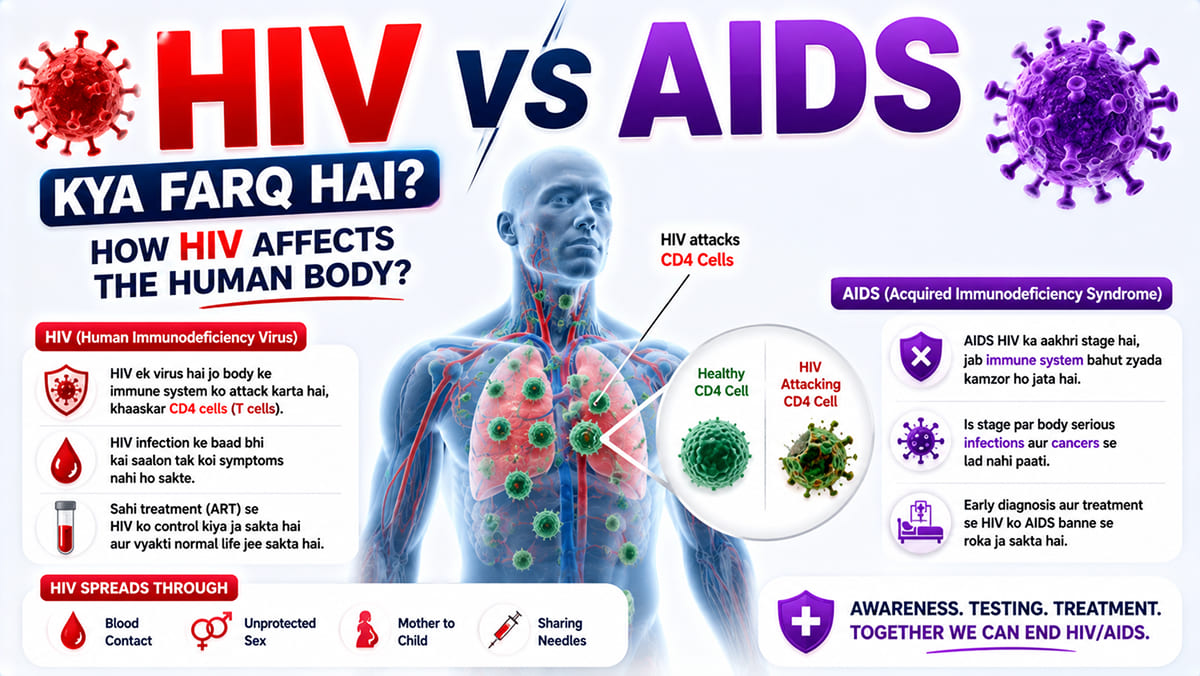
HIV vs. AIDS: What is the Difference? The Medical Science of the Immune System
In the realm of modern medical science and virology, there are few acronyms as universally recognized—and as deeply misunderstood—as HIV and AIDS. For decades, these two terms have been incorrectly used interchangeably in casual conversation, movies, and even news reports. However, from a strict biological and clinical standpoint, HIV and AIDS are not the same thing.
Understanding the exact difference between the two, and visualizing exactly how this microscopic invader destroys the human body, is the first critical step in breaking the stigma and fighting the disease. Let us take a deep, 3D medical journey into the human bloodstream to uncover the precise mechanism of HIV, its devastating effect on CD4 T-Cells, and how medical science is fighting back.
The Crucial Difference: HIV is the Cause, AIDS is the Result
To clear up the confusion immediately, we must look at the definitions:
- HIV (Human Immunodeficiency Virus): This is the actual physical, biological pathogen. It is a microscopic retrovirus that actively enters the human body and attacks the immune system. You can catch HIV.
- AIDS (Acquired Immunodeficiency Syndrome): AIDS is not a virus. It is a medical syndrome or a severe clinical condition. AIDS is the final, most advanced, and most life-threatening stage of an untreated HIV infection. You cannot "catch" AIDS; you develop it only after the HIV virus has successfully destroyed your immune system over many years.
Simply put: HIV is the weapon, and AIDS is the destruction it leaves behind. A person can live with HIV for decades without ever developing AIDS, provided they receive the correct medical treatment.
The Biological Hijack: How HIV Destroys the Body (The CD4 T-Cell)
To understand why HIV is so uniquely dangerous, we must understand the structure of the human immune system. Your immune system is like a highly trained biological military force. Within this military, there are specialized white blood cells known as CD4 T-Cells (Helper T-Cells).
Think of the CD4 T-Cell as the "Five-Star General" of your immune system. They do not directly kill bacteria or viruses. Instead, they act as the command center. When a disease enters your body, the CD4 T-cells detect it and send out chemical signals (cytokines) to activate the "soldiers"—the B-cells that make antibodies and the Killer T-cells that destroy the infection.
Here is the terrifying brilliance of HIV: Instead of fighting the soldiers, HIV specifically targets and assassinates the Generals. Here is exactly how the 3D biological hijack happens:
1. Attachment and Entry
When HIV enters the bloodstream, its outer shell is covered in specialized protein spikes (Glycoproteins, specifically gp120). These spikes are perfectly shaped to act like a biological key. They lock perfectly onto the CD4 receptors found on the surface of your Helper T-cells. Once attached, the virus fuses its membrane with the cell and injects its deadly viral core directly into the healthy T-cell.
2. Reverse Transcription (The Trojan Horse)
HIV is a Retrovirus. This means its genetic material is made of RNA, not DNA. Once inside the T-cell, the virus uses a special enzyme called Reverse Transcriptase to convert its viral RNA into human-compatible DNA. The virus then sneaks this newly formed viral DNA straight into the nucleus (the brain) of your healthy cell and permanently stitches it into your own human DNA.
3. Replication and Destruction
Once the viral DNA is integrated, the human cell is completely hijacked. The CD4 T-cell forgets its job as an immune system general and becomes a mindless biological factory. The cell starts rapidly manufacturing thousands of new HIV viral clones. Eventually, the cell becomes so full of new viruses that it violently bursts open (Lysis) and dies. The thousands of newly released HIV clones then swim into the blood to hunt down and hijack thousands of other healthy CD4 T-cells. This vicious cycle completely decimates the body's immune defense.
How is HIV Actually Transmitted? (Breaking the Myths)
Because HIV is a fragile virus that cannot survive long outside the human body, it can only be transmitted through the direct exchange of specific bodily fluids: blood, semen, vaginal fluids, and breast milk. The scientifically proven routes of transmission include:
- Unprotected Sexual Contact: Having unprotected intercourse with an infected individual is the most common mode of transmission worldwide.
- Infected Blood Transfusions: Receiving blood that has not been rigorously tested for the virus.
- Sharing Infected Needles: Intravenous drug users who share syringes inject the live virus directly into their bloodstream.
- Mother-to-Child Transmission: A pregnant mother carrying the virus can pass it to her baby during pregnancy, childbirth, or through breastfeeding.
How HIV Does NOT Spread:
It is equally important to know how the virus does not spread to prevent unnecessary fear and social stigma. You cannot get HIV from: Hugging, shaking hands, kissing, sharing food or utensils, using the same toilet, swimming pools, or from mosquito and insect bites.
The Final Stage: What Exactly is AIDS?
A healthy human adult has a CD4 T-cell count ranging from 500 to 1,500 cells per cubic millimeter of blood.
As HIV silently destroys these cells over a period of 5 to 10 years, the immune system becomes progressively weaker. When a patient's CD4 count drops below 200 cells per cubic millimeter, their immune system is considered completely collapsed. At this exact clinical threshold, the patient is officially diagnosed with AIDS.
At the AIDS stage, the body is so incredibly weak that it cannot even fight off standard, everyday bacteria. Patients do not actually die directly from the HIV virus; they die from Opportunistic Infections. Diseases that a normal immune system would crush in a day—such as mild pneumonia, common fungal infections, or rare cancers like Kaposi's sarcoma—become overwhelming and fatally destructive to an AIDS patient.
Medical Hope: Antiretroviral Therapy (ART)
Decades ago, contracting HIV was considered an absolute death sentence. Today, medical science has achieved a spectacular breakthrough. While there is still no 100% cure or vaccine for HIV, doctors can effectively stop the virus using a daily regimen of medications known as Antiretroviral Therapy (ART).
ART drugs are highly advanced chemical blockers. They specifically target and disable the enzymes that the virus uses to copy itself (like Reverse Transcriptase and Protease). Because the virus can no longer replicate, the massive viral army in the blood dies off. This gives the patient's bone marrow enough time to produce fresh, new CD4 T-cells and rebuild the immune system.
If an HIV-positive patient takes their ART medication strictly every single day, their viral load can become so low that it is completely Undetectable in standard blood tests. Medical science has proven a groundbreaking fact: Undetectable = Untransmittable (U=U). This means an HIV-positive person on successful ART cannot pass the virus to their sexual partners, and they can go on to live a completely normal, healthy, and long life.
Conclusion
HIV is a masterclass in viral evolution, a microscopic entity that attacks the very defense system designed to destroy it. However, human medical science has proven to be stronger. Prevention remains the absolute best cure—always practice safe sex, never share needles, and ensure blood is tested before transfusions. With early testing, massive public awareness, and modern Antiretroviral Therapy, we have the scientific power to completely defeat this virus and end the AIDS epidemic forever.
For more deeply fascinating, science-backed 3D medical animations and anatomy explorations, be sure to subscribe to Medscope Visuals on YouTube! Let us know in the comments which disease or bodily function you want us to explain next!