
Khoon Chadhane Se Pehle Blood Group Match Karna Kyu Zaroori Hai? | Blood Group Explained
Khoon Chadhane Se Pehle Blood Group Match Karna Kyu Zaroori Hai? The Science of Blood Groups To the naked eye, all human blood looks exactly the same. It is a thi...
Medically Reviewed By
Medscope Editorial Team Verified
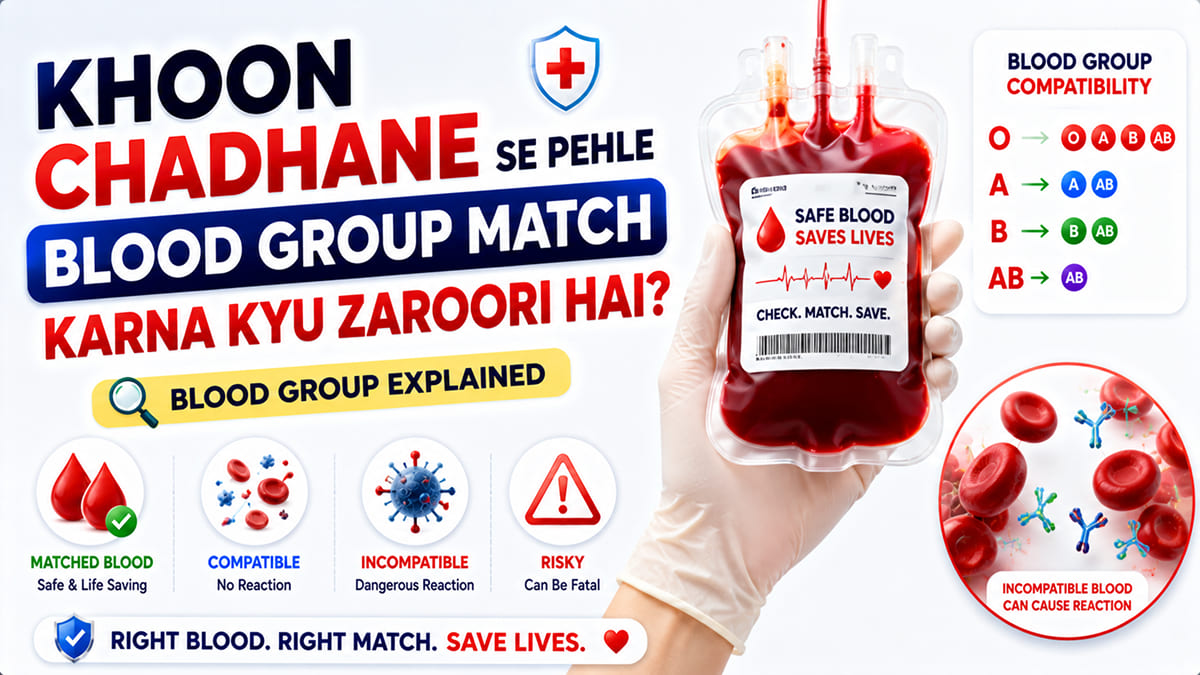
Khoon Chadhane Se Pehle Blood Group Match Karna Kyu Zaroori Hai? The Science of Blood Groups
To the naked eye, all human blood looks exactly the same. It is a thick, bright red fluid that keeps us alive. However, if a patient is bleeding heavily and needs an emergency blood transfusion, a doctor cannot simply take blood from any random person and pump it into the patient's veins. Doing so without testing could result in a rapid, agonizing, and completely fatal medical disaster.
So, why is this the case? If everyone’s blood looks identically red, why can a mismatched blood transfusion kill a person within minutes? The answer lies deep within the microscopic biochemistry of our blood cells. The human immune system is incredibly aggressive and protective, and it relies on a highly specific identification system known as the ABO Blood Group System and the Rh Factor. Let us dive deep into the fascinating anatomy of our blood to understand why precise blood matching is a matter of life and death.
The Cellular ID Cards: Antigens and Antibodies
To understand how blood groups work, you must first understand the two primary biological components involved in a blood transfusion: Antigens and Antibodies. These two biological structures dictate whether your body will accept new blood or go to war against it.
- Antigens (The ID Cards): Your blood is made up of millions of Red Blood Cells (RBCs). On the outer surface of every single red blood cell, there are specialized protein and sugar molecules called Antigens. Think of antigens as biological "ID Cards" or uniform badges. They tell your immune system, "I belong here, I am part of this body."
- Antibodies (The Security Guards): Floating in the liquid portion of your blood (the Blood Plasma) are Y-shaped immune proteins called Antibodies. These are the strict security guards of your body. Their only job is to constantly patrol the bloodstream, looking for any foreign antigens (ID cards that do not match). If they find a foreign antigen, they instantly attack and destroy the invader.
The ABO Blood Group System Explained
Based on the presence or absence of two specific antigens—Antigen A and Antigen B—human blood is universally classified into four major blood types. Here is the exact chemistry of each group:
1. Blood Group A
If you have Blood Type A, your red blood cells have the A Antigen on their surface. Because your body recognizes "A" as normal, your plasma will naturally produce Anti-B Antibodies. This means your security guards are strictly instructed to attack and destroy any blood cell that has a "B" antigen on it.
2. Blood Group B
If you have Blood Type B, your red blood cells possess the B Antigen on their surface. Conversely, your plasma produces Anti-A Antibodies. If any "A" blood enters your system, your immune system will immediately trigger a massive attack against it.
3. Blood Group AB (The Universal Recipient)
Blood Type AB is biologically unique and incredibly lucky. People with this blood group have both Antigen A and Antigen B on the surface of their red blood cells. Because their body recognizes both A and B as "friendly," their plasma produces Zero Antibodies (neither Anti-A nor Anti-B).
Because they lack these security guards, a person with Blood Group AB can receive blood from Type A, Type B, Type AB, or Type O without their body launching an attack. This is exactly why individuals with AB positive blood are medically known as the Universal Recipients.
4. Blood Group O (The Universal Donor)
Blood Type O is the exact opposite of AB. The red blood cells in Type O blood have Zero Antigens on their surface (no A and no B). Because they have no ID cards, they are essentially invisible to other people's immune systems. You can give Type O blood to almost anyone, which is why Type O negative is famous as the Universal Donor blood.
However, the catch is that because Group O people have no antigens of their own, their plasma is heavily guarded by both Anti-A and Anti-B Antibodies. Therefore, a person with Type O blood can only receive Type O blood. Any other blood type will be instantly attacked.
The Rh Factor: What Does Positive (+) and Negative (-) Mean?
When you hear someone say their blood group is "B Positive" or "O Negative," the plus or minus sign refers to a completely different protein system called the Rh Factor (Rhesus Factor), specifically the D-Antigen.
- Rh Positive (+): If you have the Rh protein on the surface of your red blood cells, you are positive. (Example: A+)
- Rh Negative (-): If your red blood cells do not have this protein, you are negative. (Example: A-)
The medical rule for the Rh factor is strict: A negative person can NEVER receive positive blood. If an Rh-negative patient is given Rh-positive blood, their immune system will see the Rh protein as a dangerous foreign invader, create Anti-Rh antibodies, and launch a severe, life-threatening immune response.
The Fatal Consequence: What Happens During a Mismatch?
What actually happens inside the body if a doctor makes a mistake and gives Group A blood to a Group B patient? The result is an immediate medical catastrophe known as an Acute Hemolytic Transfusion Reaction (AHTR).
The moment the wrong blood enters the patient's vein, the massive army of security guards (antibodies) in the patient's plasma locks onto the foreign red blood cells. This triggers two deadly physiological events:
- Agglutination (Clumping): The antibodies bind the foreign red blood cells together, causing them to clump into massive, sticky clusters. These blood clumps travel through the body and severely block the tiny capillaries in the lungs, heart, and brain, cutting off oxygen and leading to strokes or heart attacks.
- Hemolysis (Exploding Cells): The immune system then punctures holes in the clustered red blood cells. The foreign cells explode, dumping massive amounts of raw, toxic hemoglobin directly into the bloodstream.
The kidneys, whose job is to filter the blood, instantly become choked and clogged by this overwhelming wave of raw hemoglobin. This leads to rapid Acute Kidney Failure. The patient's blood pressure crashes dramatically (Hypovolemic Shock), they experience a fiery burning sensation in their veins, severe chest and back pain, and without immediate emergency intervention, they will die.
Conclusion
The science of blood typing is one of the most vital discoveries in modern medical history. Before any blood transfusion takes place, laboratory technicians perform strict Cross-Matching procedures to ensure absolute compatibility between the donor and the recipient. Understanding your own blood type and the delicate balance of antigens and antibodies highlights just how brilliantly protective, yet fiercely dangerous, the human immune system can be.