
Kya Machhar Ke Kaatne Se Jaan Ja Sakti Hai? | How Malaria Affects Your Body
Kya Machhar Ke Kaatne Se Jaan Ja Sakti Hai? The Medical Science of Malaria If you were asked to name the deadliest animal on the planet, you might think of a grea...
Medically Reviewed By
Medscope Editorial Team Verified
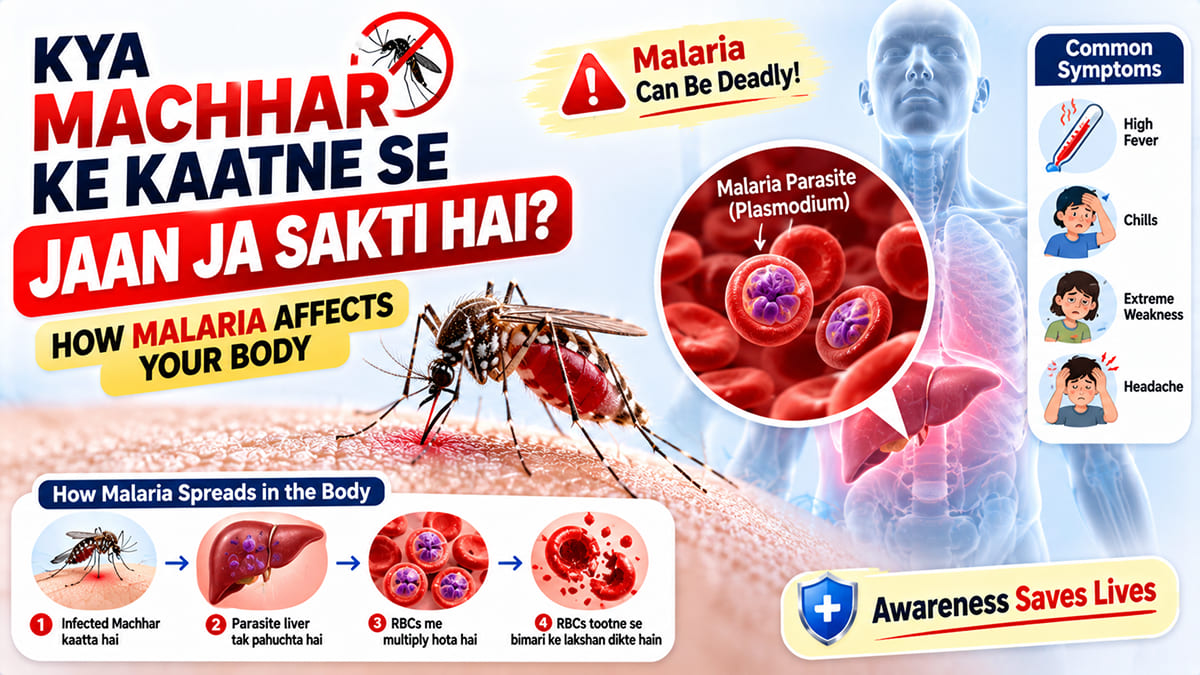
Kya Machhar Ke Kaatne Se Jaan Ja Sakti Hai? The Medical Science of Malaria
If you were asked to name the deadliest animal on the planet, you might think of a great white shark, a venomous snake, or a lion. However, medical statistics reveal a shocking truth: The deadliest creature on Earth is a tiny insect weighing less than 3 milligrams—the Mosquito. Specifically, mosquitoes are responsible for millions of deaths worldwide every year because they act as biological delivery systems for a highly destructive disease: Malaria.
But how exactly does a microscopic mosquito bite lead to a life-threatening medical emergency? To understand this, we must look inside the human bloodstream and uncover the terrifying, highly calculated biological invasion launched by the malaria parasite. Let us explore exactly how malaria attacks your organs, destroys your blood, and why it can be fatal if not treated immediately.
The Culprit: Not a Virus, Not a Bacteria, but a Parasite
One of the biggest misconceptions about Malaria is that it is caused by a virus (like Dengue) or a bacteria (like Typhoid). In reality, Malaria is caused by a microscopic, single-celled protozoan parasite called Plasmodium.
This parasite cannot fly or walk; it needs a vehicle to travel from one human to another. That vehicle (the vector) is exclusively the Infected Female Anopheles Mosquito. Why only the female? Because male mosquitoes are vegetarians who survive on plant nectar. The female mosquito desperately requires the rich proteins and iron found in human blood to develop her eggs. When an infected female mosquito pierces your skin to drink your blood, she accidentally injects her saliva into your bloodstream. Hidden inside that tiny drop of saliva are thousands of deadly Plasmodium parasites.
Stage 1: The Liver Infection (The Stealth Phase)
The moment the parasites (in a form called Sporozoites) enter your bloodstream, they do not attack immediately. They are highly intelligent biological invaders. Within just 30 to 60 minutes of the mosquito bite, the parasites rush directly into your Liver.
Once inside the liver, they violently invade your healthy liver cells (hepatocytes). This is the "incubation period," which can last anywhere from 7 to 14 days. During this time, you will feel absolutely perfectly fine. You will have no fever, no pain, and no idea that you are infected. Meanwhile, inside the liver, a single parasite is aggressively replicating and cloning itself, turning into thousands of new parasites called Merozoites. The liver cell eventually swells up so much that it physically bursts, releasing tens of thousands of these hungry parasites back into your main bloodstream.
Stage 2: The Red Blood Cell Attack (The Destruction Phase)
Now begins the truly destructive phase of the disease. The parasites (Merozoites) flowing in your bloodstream aggressively attach themselves to your Red Blood Cells (RBCs). They drill into the cell membrane and hide inside.
Inside the red blood cell, the parasite begins to literally eat your hemoglobin (the protein that carries oxygen). The parasite grows, multiplies again, and eventually destroys the red blood cell from the inside out. When millions of infected red blood cells physically explode (Hemolysis) all at the exact same time, they release massive amounts of toxic waste products, specifically a pigment called Hemozoin, directly into your blood.
The Classic Symptoms: Why Do Fever and Chills Come in Cycles?
The massive explosion of red blood cells and the sudden release of toxic hemozoin trigger your immune system to panic. Your white blood cells release inflammatory chemicals (cytokines) that travel straight to the Hypothalamus in your brain (your body's thermostat). This triggers the classic, highly specific Cyclical Symptoms of Malaria, which happen in three distinct stages:
- The Cold Stage (Severe Chills): As the brain aggressively raises your core body temperature to burn the parasites, you experience severe, uncontrollable shivering and a feeling of intense, freezing cold.
- The Hot Stage (High Fever): Next, your body temperature shoots up, often reaching a dangerously high 104°F to 106°F. This is accompanied by severe headaches, nausea, vomiting, and extreme body aches.
- The Sweating Stage: Finally, as the fever breaks, the body produces massive amounts of sweat to rapidly cool down. The patient is left utterly exhausted and deeply fatigued.
The most fascinating (and terrifying) part of Malaria is that these symptoms occur in strict cycles—usually every 48 or 72 hours. The fever completely disappears, making the patient think they are cured, only to return violently two days later. This cycle perfectly matches the exact time it takes for a new batch of red blood cells to burst!
Why is Malaria So Deadly? (The Fatal Complications)
If Malaria is not treated immediately with strong anti-malarial drugs, it can become fatal, especially if the infection is caused by the deadliest species of the parasite: Plasmodium falciparum.
- Severe Anemia: Because the parasite is literally exploding millions of your red blood cells, your body quickly runs out of oxygen-carrying cells, leading to severe, life-threatening anemia and extreme weakness.
- Cerebral Malaria (Brain Damage): The falciparum parasite has a terrifying ability. It makes the infected red blood cells "sticky." These sticky blood cells clump together and physically block the microscopic blood vessels (capillaries) inside your brain. This cuts off oxygen to the brain, causing seizures, coma, and rapid death.
- Organ Failure: These sticky blood clumps can also block the blood vessels in the kidneys and lungs, leading to acute kidney failure and pulmonary edema (fluid in the lungs).
Diagnosis and Prevention: How to Stay Safe
Because the initial symptoms of malaria (fever and body ache) mimic a normal viral infection, self-medication is highly dangerous. If you experience high fever with severe shivering, especially in a cyclical pattern, you must get a Blood Test (Peripheral Blood Smear or a Rapid Diagnostic Test) immediately. A laboratory technician can literally see the parasites hiding inside your red blood cells under a microscope.
There is currently no 100% effective, widely available vaccine for adults, meaning Prevention is the only true cure. The female Anopheles mosquito breeds exclusively in clean, stagnant water. To protect your family, you must aggressively eliminate all sources of standing water around your home (old tires, flower pots, open buckets), use highly effective mosquito repellents, and sleep under insecticide-treated mosquito nets.
A mosquito bite might be small, but the biological war it unleashes inside your body is massive. Stay alert, stay protected, and never ignore a sudden, high fever.