
Pet Ka Acid Metal Pighla Sakta Hai! | How Stomach Works
Pet Ka Acid Metal Pighla Sakta Hai: The Marvel of the Human Stomach When you eat a heavy meal, you probably don't spend much time thinking about the incredible bi...
Medically Reviewed By
Medscope Editorial Team Verified
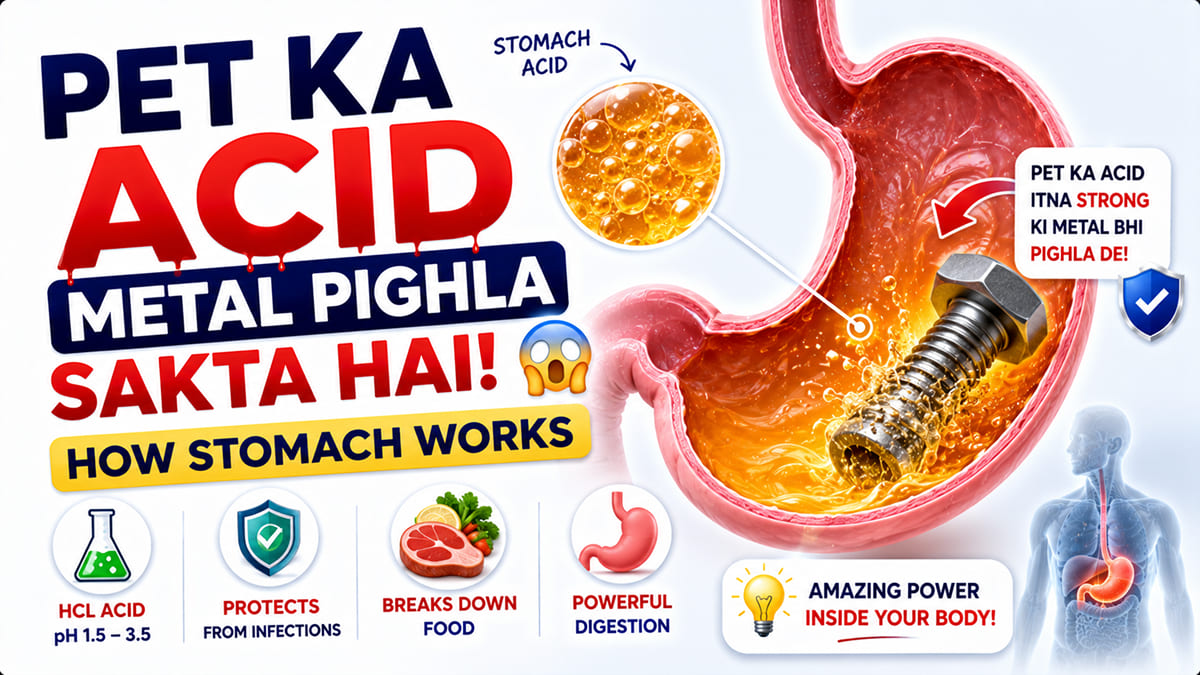
Pet Ka Acid Metal Pighla Sakta Hai: The Marvel of the Human Stomach
When you eat a heavy meal, you probably don't spend much time thinking about the incredible biochemical warfare happening right inside your abdomen. The human stomach is a highly advanced, muscular biological blender. But here is a fascinating and terrifying medical fact: The gastric acid produced by your stomach has a pH level ranging from 1.5 to 3.5. To put that into perspective, this acid is so corrosive and powerful that it can physically dissolve a razor blade or zinc metal!
This raises one of the greatest biological mysteries of the human body: If stomach acid is strong enough to dissolve solid metal, why doesn't the stomach digest and dissolve itself? To understand this incredible phenomenon, we must take a deep dive into the anatomical structure of the stomach, its highly specialized cellular machinery, and the physiological process of digestion.
The Anatomy of the Stomach: The 4 Distinct Regions
The stomach is a hollow, J-shaped muscular organ located on the left side of the upper abdomen. It is not just a single, simple sac; structurally, it is divided into four highly specific anatomical regions, each with a unique physiological job:
- 1. The Cardia: This is the very first part of the stomach. It is the entrance gateway connected to the esophagus (food pipe). Food passes through the lower esophageal sphincter (LES) and enters the cardia to begin its digestion journey.
- 2. The Fundus: This is the upper, dome-shaped section of the stomach that curves upward. Its primary job is actually storage. When you eat, the fundus expands to store undigested food and traps the swallowed gases that are produced during chemical digestion (which eventually come out as a burp).
- 3. The Body (Corpus): This is the largest, central region of the stomach. This is the main "mixing chamber" where the actual, heavy-duty chemical and mechanical digestion takes place.
- 4. The Pylorus: This is the lower, funnel-shaped part of the stomach that connects to the small intestine (duodenum). It ends with the Pyloric Sphincter—a highly sensitive, muscular valve that acts as a strict security guard, deciding exactly when the digested food is ready to exit the stomach.
The Biochemical Magic: The 4 Specialized Gastric Cells
The true magic of the stomach lies in its inner lining, known as the gastric mucosa. This lining contains millions of microscopic gastric pits, which house four highly specialized types of cells. These cells act as chemical factories to process your food:
1. Parietal Cells (The Acid Factories)
Parietal cells are arguably the most important cells in the stomach. They produce the highly potent Hydrochloric Acid (HCl). This acid has two main jobs: first, to create an extremely acidic environment that instantly kills any harmful bacteria, viruses, or pathogens that you may have swallowed with your food. Second, it aggressively unravels and denatures tough protein molecules so they can be digested.
Crucially, parietal cells also produce a protein called Intrinsic Factor—a vital chemical we will discuss later in this article.
2. Chief Cells (The Protein Breakers)
Chief cells produce an enzyme called Pepsinogen. Here is a brilliant evolutionary adaptation: Pepsinogen is completely inactive. Why? If the cell produced an active protein-destroying enzyme, the enzyme would instantly eat the cell itself! When the inactive Pepsinogen mixes with the powerful Hydrochloric Acid (from the parietal cells) in the open stomach chamber, the acid chemically transforms it into Pepsin. Pepsin is an aggressive, active enzyme that rapidly chops large protein chains (like meat) into smaller, absorbable amino acids.
3. G Cells (The Hormonal Managers)
G cells do not produce acid or enzymes; they produce hormones. When food (especially proteins) enters the stomach, G cells secrete a hormone called Gastrin directly into the bloodstream. Gastrin circulates back to the stomach and acts like an on-switch, signaling the Parietal and Chief cells to pump out massive amounts of acid and enzymes to begin digestion.
The Mystery Solved: Why Doesn't the Stomach Digest Itself?
We return to the ultimate question: How does the stomach survive its own metal-melting acid and protein-destroying pepsin? The answer lies in the fourth type of cell: the Mucous Neck Cells.
These cells constantly secrete a very thick, sticky layer of alkaline mucus that coats the entire inside wall of the stomach. This mucus is rich in Bicarbonate, which is highly basic (the opposite of acidic). This creates a physical and chemical shield. While the center of the stomach is a raging pool of acid (pH 2.0), the thick mucus barrier resting against the stomach wall neutralizes the acid on contact, keeping the tissue completely safe. When this mucus layer is damaged (often by H. pylori bacteria or NSAID painkillers), the acid burns a hole in the stomach wall, resulting in a Peptic Ulcer.
Mechanical Digestion: The Creation of "Chyme"
While the chemicals do their job, the stomach also works mechanically. Unlike other organs that have two layers of muscle, the stomach has three layers of smooth muscle (longitudinal, circular, and oblique).
These muscles violently contract every 15 to 25 seconds, creating strong mixing waves. They crush, mash, and vigorously blend the solid food with the gastric juices. After 2 to 4 hours of this intense blending, your solid meal is transformed into a soupy, highly acidic, semi-liquid paste called Chyme. The pyloric sphincter then slowly squirts this chyme into the small intestine, a few milliliters at a time, for final nutrient absorption.
The Most Critical Function: The Vitamin B12 Connection
Here is a shocking medical revelation: The stomach is an amazing organ, but it is not strictly necessary for digesting food. A patient can have their entire stomach surgically removed (Gastrectomy) due to cancer, and the intestines and pancreas will eventually adapt and take over the digestion process.
However, there is exactly one essential, life-saving function the stomach performs that no other organ can replicate: The production of Intrinsic Factor by the Parietal cells.
Intrinsic Factor is absolutely required for your body to absorb Vitamin B12 in the small intestine. Without Vitamin B12, your body cannot produce mature red blood cells (leading to Pernicious Anemia), and your brain and nervous system cannot maintain the myelin sheath around nerves, leading to severe, irreversible neurological damage. Therefore, the stomach's true biological superpower isn't just melting food with acid—it is keeping your entire nervous system alive and functioning.