
Pulse Oximeter Kaise Kaam Karta Hai? | SpO2 & Oxygen Saturation (3D Animation)
How Does a Pulse Oximeter Work? Understanding SpO2 A Pulse Oximeter is a small, non-invasive, clip-like device that attaches to a patient's fingertip. It has beco...
Medically Reviewed By
Medscope Editorial Team Verified
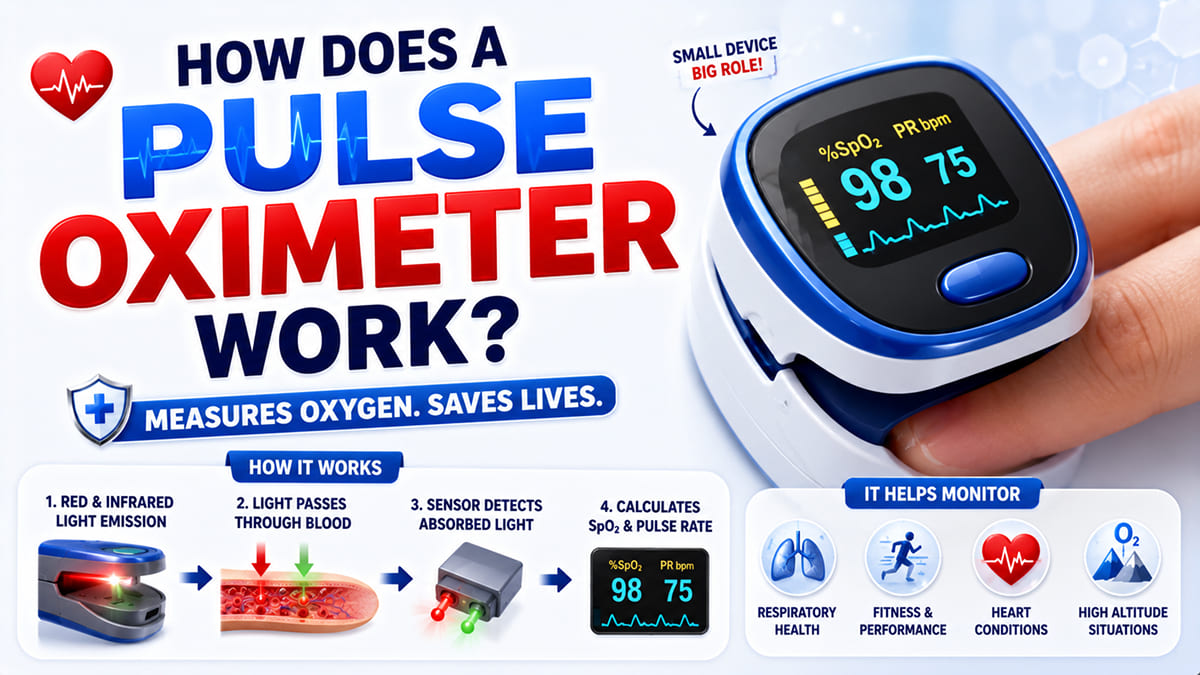
How Does a Pulse Oximeter Work? Understanding SpO2
A Pulse Oximeter is a small, non-invasive, clip-like device that attaches to a patient's fingertip. It has become an essential medical tool in hospitals and homes worldwide. Its primary job is to measure Oxygen Saturation (SpO2)—which tells you exactly what percentage of your red blood cells are successfully carrying oxygen from your lungs to the rest of your body.
The Science of Hemoglobin and Light
Inside your red blood cells is an iron-rich protein called Hemoglobin. Hemoglobin acts like a microscopic taxi cab, picking up oxygen molecules in the lungs and dropping them off at tissues.
The genius of the pulse oximeter relies on a specific law of physics: Hemoglobin absorbs light differently depending on whether it is carrying oxygen or not.
- Oxygenated Hemoglobin (carrying oxygen) absorbs more Infrared light and lets red light pass through. This is why healthy, oxygen-rich blood appears bright red.
- Deoxygenated Hemoglobin (empty of oxygen) absorbs more Red light and lets infrared light pass through. This makes oxygen-depleted blood appear darker or slightly blue.
The Mechanism: Photoplethysmography
When you place your finger inside the oximeter, here is exactly what happens step-by-step:
- On the top side of the clip, there are tiny LED lights. They shine two distinct beams of light directly through your finger tissue: one is visible Red light, and the other is invisible Infrared light.
- On the bottom side of the clip (touching the pad of your finger), there is a highly sensitive electronic photodetector.
- As the light passes through your finger, the blood in your capillaries absorbs some of it. The photodetector measures exactly how much of the Red light vs. the Infrared light made it through to the other side.
- The device's internal microchip uses a complex mathematical algorithm to compare the ratio of absorbed red and infrared light. Based on this ratio, it calculates the exact percentage of oxygenated hemoglobin in your blood.
Normal SpO2 Values
In a healthy individual, a normal pulse oximeter reading (SpO2) is between 95% and 100%. If the reading drops below 90% (a condition called hypoxemia), it indicates that the lungs or heart are failing to deliver enough oxygen to the body, requiring immediate medical evaluation and supplemental oxygen therapy.
Why Pulse Oximeter Readings Can Be Wrong
A pulse oximeter is useful, but it is not perfect. Readings can become inaccurate if the finger is cold, the patient has poor peripheral circulation, the hand is moving, nail polish blocks light, the sensor is placed incorrectly, or the device is low quality. Carbon monoxide poisoning is especially dangerous because the oximeter may show a falsely normal SpO2 even though hemoglobin is carrying carbon monoxide instead of oxygen. Severe anemia, shock, and dark ambient light can also affect accuracy.
How to Use a Pulse Oximeter Correctly
- Warm the Hand: Cold fingers reduce blood flow and can produce unstable readings.
- Keep Still: Movement creates signal noise and false alarms.
- Wait for Stability: Do not trust the first number instantly; wait until the waveform or pulse signal is steady.
- Compare With Symptoms: Breathlessness, cyanosis, confusion, chest pain, or very fast breathing matters even if the number looks acceptable.
For students and caregivers, the key point is simple: SpO2 is one piece of clinical assessment, not the full diagnosis.