
Sharir Par Baal Kyu Hote Hai? | The Science of Body Hair
Sharir Par Baal Kyu Hote Hai? The Hidden Medical Science of Body Hair When we look at ourselves in the mirror, we often view body hair as a cosmetic nuisance. Mil...
Medically Reviewed By
Medscope Editorial Team Verified
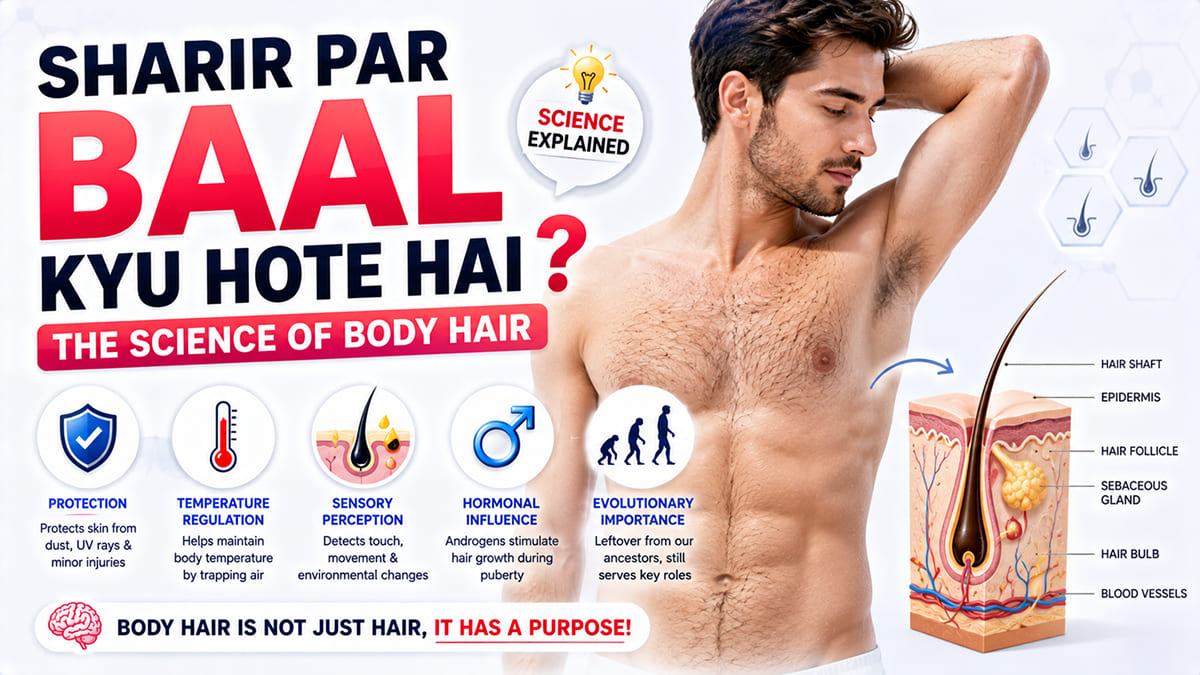
Sharir Par Baal Kyu Hote Hai? The Hidden Medical Science of Body Hair
When we look at ourselves in the mirror, we often view body hair as a cosmetic nuisance. Millions of people spend massive amounts of time and money shaving, waxing, and lasering off the hair on their arms, legs, and bodies to achieve smooth skin. This widespread practice raises a very fundamental biological question: If we are constantly trying to remove our body hair, why does the human body spend so much energy growing it in the first place? Is body hair just a useless evolutionary leftover, or does it serve a secret medical purpose?
To understand the true function of body hair, we must look at human biology through the lens of evolution and dermatology. While it is true that our ancient ancestors possessed thick, dense fur like modern-day apes, human evolution caused us to lose that heavy coat. However, the hair did not completely disappear. Instead, it evolved into a highly advanced, microscopic defense and regulatory system. Let us dive deep into the fascinating anatomy and science of human body hair.
The Anatomy of a Hair Follicle: More Than Just Dead Cells
The hair that you see above your skin (the hair shaft) is technically made of dead keratinized cells. However, the true magic happens beneath the surface of the skin. Every single strand of hair on your body is rooted in a complex biological structure called the Hair Follicle.
The hair follicle is a living, highly active mini-organ. It is deeply connected to your central nervous system through an intricate network of sensory nerve endings. It is also connected to your vascular system via a tiny blood supply at the base (the hair bulb) and has its own dedicated oil producer known as the Sebaceous Gland, which secretes natural oils (sebum) to keep your skin naturally waterproof and moisturized.
Function 1: The Ultimate Thermoregulator (Temperature Control)
One of the most critical functions of body hair is its ability to act as a dynamic biological thermostat, helping you survive in both freezing cold and blistering heat.
The Cold Defense: The Science of Goosebumps
Have you ever wondered why your hair "stands on end" when you feel a sudden chill or step into a freezing room? At the base of every single hair follicle lies a microscopic, involuntary smooth muscle called the Arrector Pili muscle.
When the temperature drops, your brain's sympathetic nervous system fires a signal directly to these muscles. The Arrector Pili muscles instantly contract and tighten, physically pulling the hair shaft perfectly straight up. On the surface of the skin, this creates tiny bumps that we commonly call Goosebumps (Piloerection).
But why does this happen? When millions of body hairs stand up simultaneously, they act like a biological blanket. They physically trap a thick layer of warm air right next to your skin, preventing your core body heat from escaping into the freezing environment. While our hair is much thinner than an animal's winter coat, this mechanism still provides a crucial layer of thermal insulation.
The Heat Defense: The Evaporation Accelerator
Surprisingly, body hair also keeps you cool during extreme heat. When you exercise or stand in the hot sun, your body produces sweat to cool down. However, sweat only cools the body when it actually evaporates into the air. Body hair massively increases the surface area of your skin. The hairs draw the sweat away from the flat surface of the skin, spreading it out along the shafts of the hair, allowing it to evaporate much faster and more efficiently, thus rapidly cooling your blood temperature.
Function 2: The Biological Sensory Radar
While human hair is not as thick as animal fur, it is incredibly sensitive. Think of your body hair as a highly advanced, 360-degree early warning radar system.
As mentioned earlier, the root of every single hair is tightly wrapped in highly sensitive nerve endings known as Mechanoreceptors. These nerves are so incredibly precise that they can detect the microscopic movement of a single hair being shifted by a fraction of a millimeter.
Why is this important? Before the invention of modern medicine, humans were constantly exposed to dangerous, disease-carrying parasites like ticks, fleas, spiders, and mosquitoes. If a tiny, lightweight insect lands on your arm and starts walking toward a blood vessel, it might be too light to trigger the pressure sensors on your actual skin. However, as the insect walks, it must push past your body hair. The bending of the hair instantly triggers the mechanoreceptors, sending a lightning-fast danger signal to your brain. You feel a tickle, become immediately alert, and swat the dangerous insect away long before it has the chance to bite you and transmit a deadly disease like Malaria or Lyme disease.
Function 3: The Ultimate Anti-Friction Defense
If you observe human anatomy closely, you will notice that terminal (thick) hair grows most densely in specific areas where limbs meet the torso, such as the armpits (axilla) and the groin area. This is not a biological accident; it is an incredibly clever mechanical design.
Humans are built for extreme endurance running and walking. When you move, the skin of your arms constantly rubs against your chest, and the skin of your inner thighs constantly rubs together. If these areas were completely hairless, the constant skin-on-skin friction combined with salty sweat would cause severe, agonizing chafing. The raw skin would eventually tear, opening the door for severe bacterial and fungal infections.
The hair in these specific regions acts as a biological dry lubricant. Instead of raw skin violently rubbing against raw skin, the layers of hair glide smoothly over one another. This brilliant friction-reduction system completely protects the delicate skin folds from mechanical damage, allowing humans to run and walk for massive distances without injury.
Conclusion: Not a Flaw, But a Masterpiece
The next time you look at the hair on your arms or legs, do not view it as a cosmetic flaw or a useless evolutionary mistake. Your body hair is an incredibly sophisticated, multi-purpose physiological system. It acts as a highly sensitive radar to protect you from venomous bites, it manipulates microscopic muscles to regulate your core body temperature, and it provides a critical lubricating barrier to protect your moving joints.
Human body hair is a perfect testament to the brilliance of biological engineering—proving that inside the human body, absolutely nothing is truly useless.
For more deeply fascinating, science-backed 3D medical animations, be sure to subscribe to Medscope Visuals on YouTube! Let us know in the comments which medical mystery you want us to explore next!