
12 Cranial Nerves in 50 Seconds! | 3D Anatomy Cheat Sheet
The 12 Cranial Nerves: Anatomy Overview The human brain has 12 pairs of cranial nerves that emerge directly from the brain and brainstem, bypassing the spinal cor...
Medically Reviewed By
Medscope Editorial Team Verified
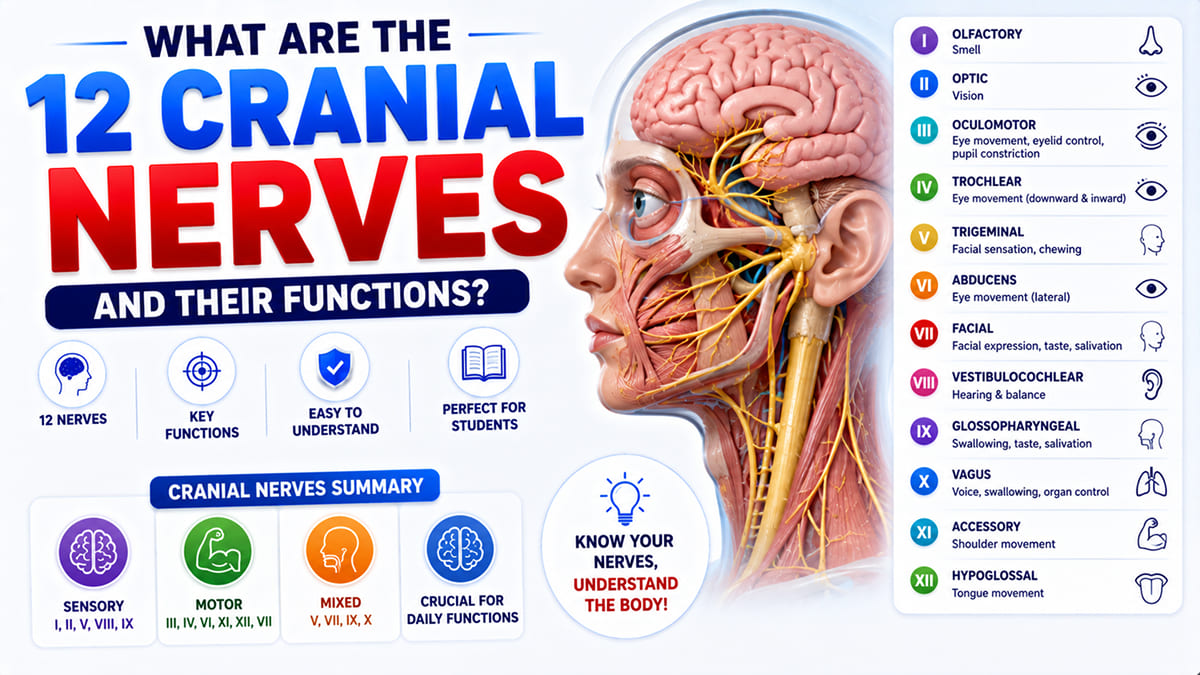
The 12 Cranial Nerves: Anatomy Overview
The human brain has 12 pairs of cranial nerves that emerge directly from the brain and brainstem, bypassing the spinal cord. These nerves are responsible for transmitting sensory information, controlling facial and eye muscles, and regulating parasympathetic functions. For medical, dental, and nursing students, memorizing their names, numbers, and functions is a fundamental anatomy requirement.
Mnemonic to Remember the 12 Cranial Nerves
A classic medical mnemonic to remember the order of the nerves is: "Oh Oh Oh To Touch And Feel Very Good Velvet, Such Heaven!"
To remember if a nerve is Sensory (S), Motor (M), or Both (B), use: "Some Say Marry Money But My Brother Says Big Brains Matter More."
Cheat Sheet: Names and Clinical Functions
- CN I - Olfactory Nerve (Sensory): Responsible for the sense of smell.
- CN II - Optic Nerve (Sensory): Transmits visual information from the retina to the brain for sight.
- CN III - Oculomotor Nerve (Motor): Controls most eye movements, pupil constriction, and keeping the eyelid open.
- CN IV - Trochlear Nerve (Motor): Moves the superior oblique muscle of the eye (looking down and inward).
- CN V - Trigeminal Nerve (Both): The largest cranial nerve. It provides sensation to the face and controls the muscles of mastication (chewing).
- CN VI - Abducens Nerve (Motor): Controls the lateral rectus muscle, moving the eye outward (laterally).
- CN VII - Facial Nerve (Both): Controls facial expressions, tear/saliva production, and taste on the anterior two-thirds of the tongue.
- CN VIII - Vestibulocochlear Nerve (Sensory): Responsible for hearing and maintaining body balance/equilibrium.
- CN IX - Glossopharyngeal Nerve (Both): Controls the gag reflex, swallowing, and taste on the posterior one-third of the tongue.
- CN X - Vagus Nerve (Both): The longest cranial nerve. It regulates the heart rate, digestion, and parasympathetic control of the internal organs.
- CN XI - Accessory Nerve (Motor): Controls the sternocleidomastoid and trapezius muscles (shrugging shoulders and turning the head).
- CN XII - Hypoglossal Nerve (Motor): Controls the movements of the tongue for speech and swallowing.
How Cranial Nerves Are Tested Clinically
Cranial nerve examination helps locate neurological problems in the brainstem, skull base, face, eyes, and throat. CN I may be tested with familiar smells. CN II is checked through visual acuity, visual fields, and pupillary response. Eye movements test CN III, IV, and VI. Facial sensation and chewing assess CN V, while facial expressions test CN VII. Hearing and balance relate to CN VIII. Gag reflex, palate movement, swallowing, and voice quality assess CN IX and X. Shoulder shrug tests CN XI, and tongue movement tests CN XII.
Why Cranial Nerve Knowledge Matters
Cranial nerve findings can point to serious conditions such as stroke, raised intracranial pressure, Bell's palsy, trigeminal neuralgia, acoustic neuroma, brainstem lesions, or skull fracture. For example, unequal pupils may suggest CN III involvement, facial droop may involve CN VII or a central stroke pathway, and tongue deviation may suggest hypoglossal nerve weakness. Students should learn the number, name, modality, and main function together, because clinical exams rarely ask isolated facts. They ask what a patient cannot do and which nerve is likely affected.