
Hamare Sirf 32 Teeth Kyu Hote Hai? | Evolution of Teeth (3D Animation)
Why Do We Have 32 Teeth? The Evolution of Human Dentistry If you count the teeth of a healthy human adult, you will usually find exactly 32. But why this specific...
Medically Reviewed By
Medscope Editorial Team Verified
Why Do We Have 32 Teeth? The Evolution of Human Dentistry
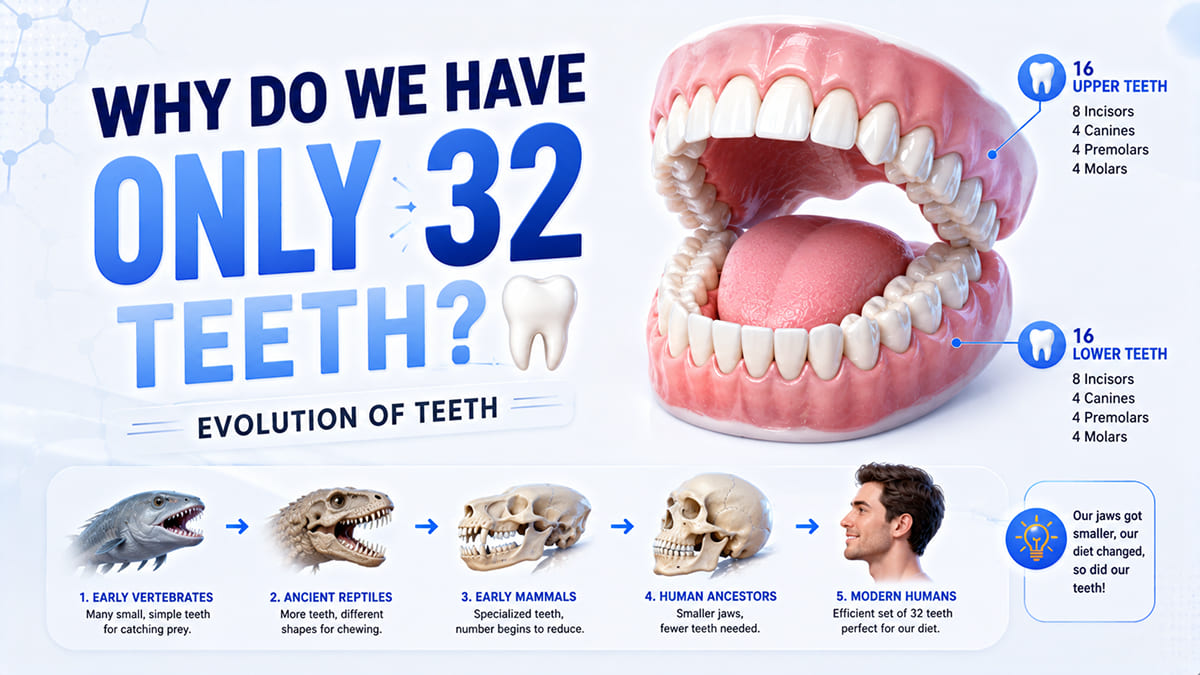
If you count the teeth of a healthy human adult, you will usually find exactly 32. But why this specific number? The structure and count of our teeth are a direct result of millions of years of evolutionary biology, specifically adapted to the changing diet and jaw size of our ancient ancestors.
The Human Dental Formula
In anatomy, an adult's 32 teeth are perfectly divided across the upper arch (maxilla) and lower arch (mandible). These teeth are highly specialized for different functions in mechanical digestion:
- 8 Incisors: The sharp, flat front teeth used for cutting and biting into food (like an apple).
- 4 Canines: The pointed teeth next to the incisors, designed for tearing and ripping tough food like meat.
- 8 Premolars (Bicuspids): These have flat surfaces with ridges, used for crushing food.
- 12 Molars: The largest back teeth, designed for heavy-duty grinding and chewing to turn food into a swallowable mass.
Evolution and the Shrinking Human Jaw
Millions of years ago, early hominids (our ancestors) survived on a rough, tough diet of raw meat, uncooked roots, leaves, and nuts. To chew this difficult food, they needed a massive, powerful jaw and all 32 teeth (including the large third molars) for extreme grinding power.
However, as human evolution progressed, we discovered fire and cooking. Cooking softened our food drastically, meaning we no longer needed such massive jaw strength. Over thousands of years, the human brain grew larger, and the jawbone evolved to become much smaller and narrower.
The Problem with Wisdom Teeth
Because our modern jawbones are now significantly smaller than those of our ancestors, there is often not enough physical space for the final four teeth to emerge. These are the third molars, commonly known as Wisdom Teeth.
Baby Teeth vs. Permanent Teeth
Children do not begin life with 32 teeth. Most children develop 20 primary teeth, also called baby teeth or milk teeth. These teeth help with chewing, speech development, and jaw growth, but they also hold space for the permanent teeth underneath. Around age 6, the first permanent molars usually erupt behind the baby teeth. Over the next several years, baby teeth fall out and are replaced by permanent incisors, canines, premolars, and molars. The final wisdom teeth often appear between ages 17 and 25, although some people never develop all four.
Why Dental Alignment and Oral Hygiene Matter
Having 32 teeth is useful only when the teeth are properly aligned and easy to clean. Crowded teeth trap food particles and plaque, increasing the risk of cavities, gum disease, bad breath, and dental pain. Wisdom teeth that are partially erupted can create a gum flap where bacteria collect, leading to pericoronitis, swelling, and difficulty opening the mouth. Regular brushing with fluoride toothpaste, flossing, dental checkups, and early orthodontic evaluation help protect both function and appearance. If a wisdom tooth is impacted, repeatedly infected, or damaging the second molar, a dentist or oral surgeon may advise removal.
When wisdom teeth try to push through the gums in a jaw that is too small, they often become impacted (stuck at an angle), causing severe pain, crowding, and infection, which is why they frequently require surgical extraction today. They are a classic example of a vestigial structure—something we inherited from evolution but no longer actually need.