
Facial Droop & Weakness… Stroke or Low Blood Sugar? | Neuroglycopenia in 3D
Facial Droop: Is it a Stroke or Hypoglycemia? When a patient presents to the emergency room with sudden facial droop, slurred speech, and one-sided weakness (hemi...
Medically Reviewed By
Medscope Editorial Team Verified
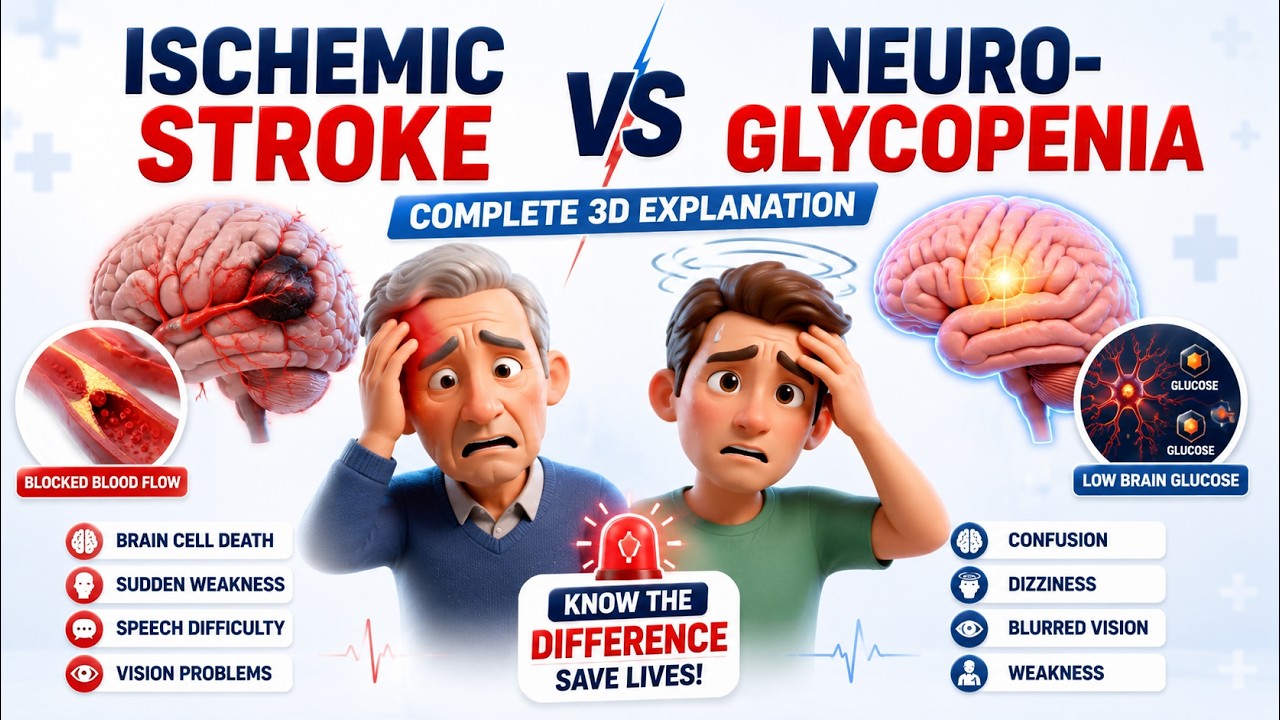
Facial Droop: Is it a Stroke or Hypoglycemia?
When a patient presents to the emergency room with sudden facial droop, slurred speech, and one-sided weakness (hemiparesis), the immediate clinical suspicion is always a Stroke (Cerebrovascular Accident - CVA). However, there is a dangerous medical mimic that presents with identical symptoms: Neuroglycopenia caused by severe hypoglycemia (low blood sugar).
Understanding Stroke Pathophysiology
A stroke occurs when the blood supply to a part of the brain is suddenly interrupted. This usually happens in two ways:
- Ischemic Stroke: A blood clot blocks an artery in the brain, cutting off oxygen and glucose to the neurons.
- Hemorrhagic Stroke: A blood vessel bursts, causing bleeding inside or around the brain tissue, increasing intracranial pressure.
The "FAST" protocol (Face drooping, Arm weakness, Speech difficulty, Time to call 911) is universally used to identify a stroke. Rapid imaging (CT Scan) is required to determine the type.
What is Neuroglycopenia? (The Stroke Mimic)
The brain relies exclusively on glucose for energy. It cannot store glucose, nor can it use fat for fuel like muscles do. When a patient's blood sugar drops to dangerously low levels (hypoglycemia), the brain begins to starve. This state of brain starvation is called Neuroglycopenia.
Because different parts of the brain may react to glucose deprivation at different rates, a patient can develop focal neurological deficits. They might experience acute facial drooping, aphasia (inability to speak), and unilateral arm weakness—perfectly mimicking an acute ischemic stroke.
The Crucial Clinical Assessment (CBG Test)
For paramedics and ER nurses, differentiating between a stroke and neuroglycopenia is a matter of seconds. Treating a hypoglycemic patient with stroke medications (like thrombolytics) can be fatal.
The Rule: Before calling a "Stroke Alert," you must always check the patient's Capillary Blood Glucose (CBG) level. If the blood sugar is critically low (e.g., below 60 mg/dL), administering IV Dextrose (D50) will almost instantly reverse the facial droop and weakness, proving it was a mimic. If the glucose is normal, the stroke protocol must be initiated immediately.
Other Common Stroke Mimics
Hypoglycemia is one of the most important stroke mimics because it is rapidly reversible, but it is not the only one. Seizure with postictal weakness, migraine with aura, Bell's palsy, brain tumor, electrolyte imbalance, intoxication, and functional neurological disorders can also resemble stroke. The danger is that true stroke treatment is highly time-sensitive, so clinicians must rule out mimics quickly without delaying imaging and specialist evaluation.
Emergency Assessment Priorities
- Check Glucose: A bedside CBG test should be done immediately in any patient with sudden neurological deficit.
- Note Last Known Well: Thrombolysis and thrombectomy decisions depend heavily on symptom timing.
- Perform FAST/BE-FAST: Assess balance, eyes, face, arms, speech, and time of onset.
- Do Not Give Food or Water: Dysphagia is common in stroke and can cause aspiration.
For nurses and paramedics, the safest mindset is: treat hypoglycemia immediately if present, but never dismiss persistent facial droop or weakness without full stroke evaluation.
Documentation should include symptom onset, blood glucose value, treatment given, neurological response after glucose correction, vital signs, and communication with the stroke team. Clear documentation helps distinguish a reversible mimic from an evolving neurological emergency.