
How Your Brain Sends Signals | Action Potential in 3D
How Your Brain Sends Signals: The Action Potential The human nervous system is an incredibly complex network, but at its core, it communicates using tiny electric...
Medically Reviewed By
Medscope Editorial Team Verified
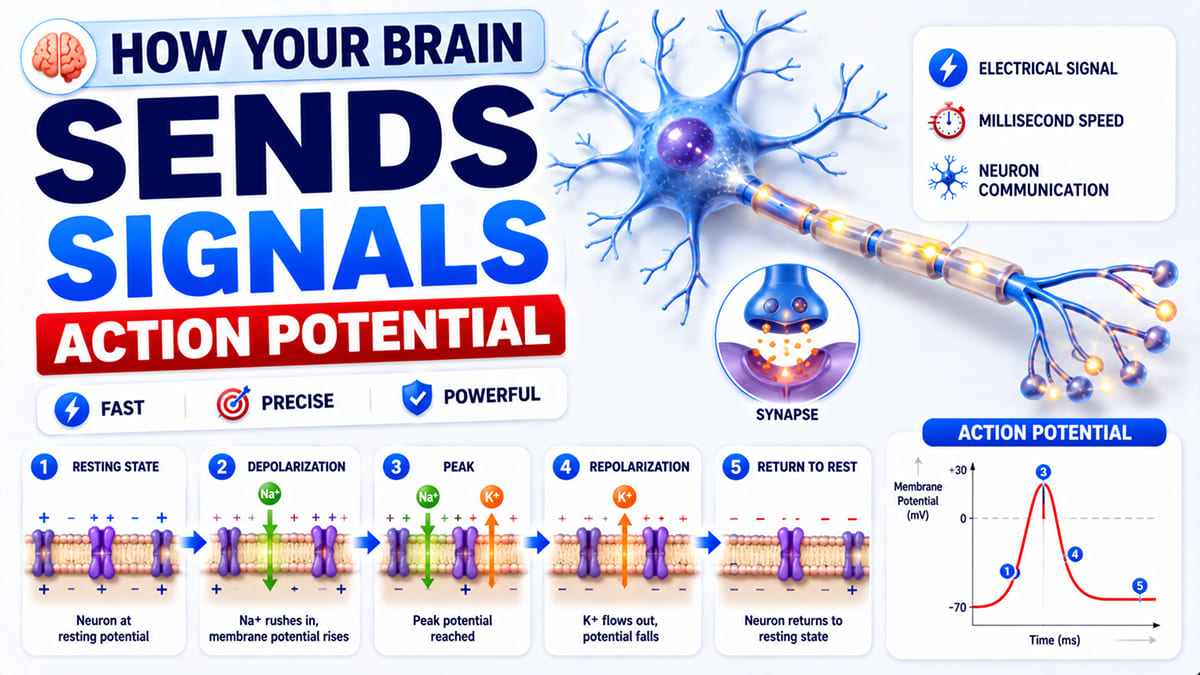
How Your Brain Sends Signals: The Action Potential
The human nervous system is an incredibly complex network, but at its core, it communicates using tiny electrical impulses. Neurons (nerve cells) do not physically touch each other; instead, they transmit information rapidly down their axons using a physiological process known as the Action Potential. Understanding this concept is fundamental to neurobiology and pharmacology.
The Resting Membrane Potential (The Starting Point)
Before a signal is sent, a neuron is "at rest." However, it is not idle. The cell membrane acts like a battery, maintaining an electrical charge difference between the inside and outside of the cell. The inside of the neuron is negatively charged (usually around -70 mV) compared to the outside. This is maintained by the Sodium-Potassium Pump, which actively pumps 3 Sodium (Na+) ions out of the cell for every 2 Potassium (K+) ions it pumps in.
The Stages of an Action Potential
When a neuron receives a strong enough stimulus (crossing the threshold of -55 mV), it fires an action potential. This occurs in three rapid stages:
- Depolarization (The Spike): Voltage-gated sodium channels suddenly burst open. Positively charged Sodium (Na+) ions rush into the cell. The inside of the cell rapidly becomes positive, spiking up to about +30 mV. This electrical spike is the actual signal traveling down the nerve.
- Repolarization (The Reset): Just as quickly, the sodium channels close, and voltage-gated Potassium (K+) channels open. Potassium rushes out of the cell, carrying its positive charge away, which brings the inside of the cell back toward a negative voltage.
- Hyperpolarization (The Overshoot): The potassium channels are slow to close, allowing too much potassium to leave. The cell temporarily becomes more negative than its resting state (around -90 mV). This creates a "refractory period" where the neuron cannot fire another signal immediately, ensuring signals only travel in one direction.
Finally, the Sodium-Potassium pump kicks back into high gear, restoring the ionic balance and returning the neuron to its precise resting membrane potential, ready for the next signal.
Why Myelin Makes Nerve Signals Faster
Many neurons are wrapped in a fatty insulating layer called myelin. In the brain and spinal cord, myelin is produced by oligodendrocytes; in peripheral nerves, it is produced by Schwann cells. Myelin prevents electrical current from leaking out of the axon and allows the action potential to jump between small exposed gaps called nodes of Ranvier. This jumping pattern is called saltatory conduction, and it makes nerve transmission dramatically faster and more energy efficient.
Clinical Importance of Action Potentials
Action potentials explain many medical conditions and drug actions. Local anesthetics like lidocaine block voltage-gated sodium channels, preventing pain signals from traveling to the brain. Demyelinating diseases such as multiple sclerosis damage myelin, slowing or blocking nerve conduction and causing weakness, numbness, visual problems, or coordination issues. Electrolyte imbalances also matter: abnormal sodium, potassium, calcium, or magnesium levels can change nerve and muscle excitability. For students, the key concept is that every sensation, movement, reflex, heartbeat signal, and thought depends on controlled ion movement across cell membranes.